

Economical Details For Bridges: Cross Frames And Cross Frame Connections
In the past, the steel industry encouraged minimizing the amount of material in order to provide the most economical girder. Lower material costs typically offset any expense for additional fabrication and erection labor. However, today the reverse is true. Steel material costs remain very near to those of 10 years ago, while labor costs continue to increase. Thus, the most economical plate girders generally are not those with the least weight, but are those which permit easy fabrication and erection. Consequently, simple details are critical to plate girder competitiveness. This paper will describe the impact of cross frames, their connection details, and girder spacing on the overall economy of a steel plate girder bridge.
Cross Frames:
The current AASHTO Spec calls for all steel bridges to be provided with cross frames at
each support and spaced at intervals not to exceed 25 feet along the span. After the deck
is in place, research shows that cross frames are not needed and could be removed without
affecting the performance of the superstructure. They cannot, however, be completely
eliminated since there are constructibility concerns that require the use of cross frames
prior to placement of the deck.
Fabrication costs for cross frames are six times more expensive per pound than main girder material. However, since they represent only about 10% of a structure's weight, they generally receive less attention by the designer.
A typical cross frame can cost anywhere between $500 and $1,000 per frame! Thus it is important to not only use a few as practical, but also to design the most cost-effective one. Figure 1 shows one of the most economical cross frames available along with a list of comments (courtesy of Walter J. Gatti, Tensor Engineering Co.). This cross frame is estimated to cost $525.
Conclusions:
- Space cross frames as far apart as possible to limit the overall number of units, while still being consistent with constructibility criteria.
- Do not make cross frames any more complicated than necessary.
- Consider "X" frames for straight bridges with a constant cross section and parallel girders.
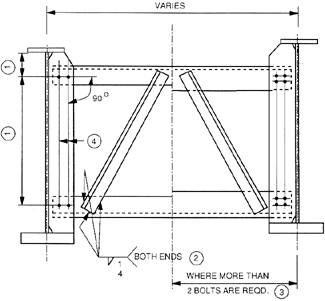
Figure 1
EXAMPLE OF AN ECONOMICAL TYPE OF CROSS FRAME
This type of cross frame requires only 4 components
- Keep these dimensions the same and slope the struts
- Keep all welding on one side
- Increase size of the struts as required for load
Economical Details for Bridges page 2
Preliminary Bridge Girder Comparisons
Span Selection for Steel Bridges
Economical Details for Bridges: Cross Frames and Cross Frame Connections
Economical Plate Selection for Bridges
Bridges  Bridges Technical
Bulletins
Bridges Technical
Bulletins
Home Financial About Divisions Steel Links Products Markets What's New
E-mail comments to: [email protected]
�1998, Bethlehem Steel Corporation