


Span Selection for Steel Bridges
Introduction:
Steel has traditionally been recognized as the material of choice for longer
spans. Because of this reputation, the steel spans selected are often far in excess of the
optimum. For greatest economy, substructure and superstructure costs need to be evaluated
with respect to span lengths. The purpose of this technical bulletin is to show a proven
method of determining the optimum span length for a steel bridge, where pier locations are
not predetermined by site conditions. Both the method and the actual project example were
provided by the Norfolk, VA office of PBQD.
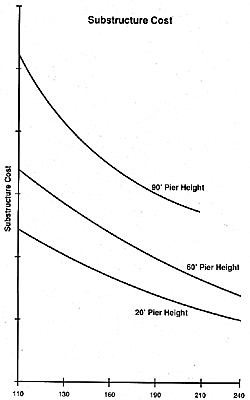
The method involves calculating the individual super- and substructure costs for a varying set of conditions. Substructure costs vary primarily by pier height, with their unit costs ($/SF) decreasing as the span increases. Superstructure costs, on the other hand, increase as the spans get larger. At some point, the combined cost for a given pier height is lowest. This then is the optimum steel span, and may not be significantly different from the optimum concrete span. This can best be illustrated by example.
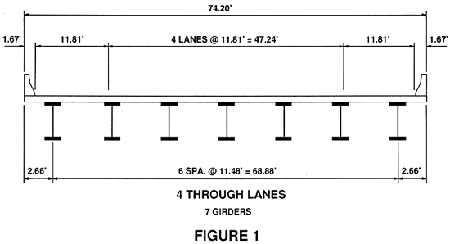
Figure 1 shows the bridge cross-section selected.
Superstructure Cost:
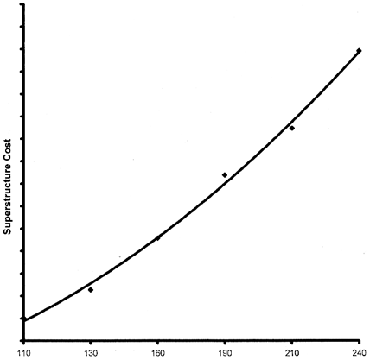
Using this cross-section, a superstructure cost estimate is prepared for various
span lengths. In order to account for variable overall bridge lengths due to different
spans, all comparisons are on a per square foot basis. By plotting the calculated costs
versus span length, the following curve for superstructure cost is generated (Figure 2).
Span Length (feet)
FIGURE 2
Substructure Cost:
Using the same procedure, substructure costs can be determined for various pier
heights. The pier costs can then be plotted by both span length and pier height (Figure3).
Span Length (feet)
FIGURE 3
Bridge Cost:
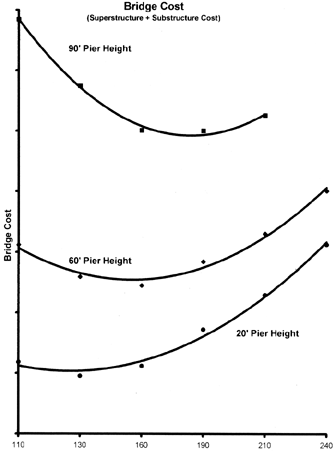
Once the curves for both substructure and superstructure have been developed, it is then
possible to construct curves representing total bridge cost by span and by pier height
(Figure 4). The lowest point on each of these curves is then the optimum span length for
the given pier height. It is interesting to note that for this example, the optimum span
length for a 20-foot high pier is only 130 feet, while the optimum span for piers 90 feet
high is about 180 feet.
Span Length (feet)
FIGURE 4
Conclusions:
- The optimum steel span length is very dependent upon substructure cost, which in turn is mainly dependent upon pier height.
- Increasing span length means larger superstructure costs.
- On projects where pier locations are not predetermined by site conditions, an analysis of both sub- and superstructure cost is necessary to select the most economical steel spans.
- The optimum steel span length could be very close to that of the concrete scheme. Do no automatically assign a larger span length to steel!
- Bethlehem Steel's Preliminary Girder Optimization Program can provide optimized girder
designs for the various spans used in computing superstructure costs.
Preliminary Bridge Girder Comparisons
Span Selection for Steel Bridges
Economical Details for Bridges: Cross Frames and Cross Frame Connections
Economical Plate Selection for Bridges
Bridges  Bridges Technical
Bulletins
Bridges Technical
Bulletins
Home Financial About Divisions Steel Links Products Markets What's New
E-mail comments to: [email protected]
�1998, Bethlehem Steel Corporation