
|
1995 Annual ReportChairman's LetterDuring 1995, we made steady progress in moving toward our Vision of being the Premier Steel Company. We accomplished this by continuing to implement our Corporate Strategy of concentrating on steel, rebuilding our financial strength and improving continuously. Operationally, we continued our focus on improving productivity and quality while reducing costs. Financially, our net income of $180 million improved by almost $100 million over last year. Also, our cash flow improved, which enabled us to continue to make improvements in our capital structure.
As we look to the years ahead, we know that the intensity
of competition will increase and that we must continuously improve
our performance. We remain committed to achieving our Corporate
Objectives of serving our customers, partnering among our employees,
being a good citizen and achieving sustained profitability and
rates of return that will increase value for our stockholders.
Concentrating On Steel
Our Burns Harbor and Sparrows Point Divisions continued
to strengthen their competitive positions in 1995. Together, these
two Divisions shipped about 7.5 million tons of steel products,
about 85 percent of Bethlehem's total steel shipments.
A significant portion of Burns Harbor's 1995 shipments
of sheet steel products went to customers in the automotive industry.
More than 90 different models of 1996 cars, vans and light trucks
are manufactured with high-quality steel from Burns Harbor. In
1995, Burns Harbor earned the coveted QS-9000 quality certification
of the Big-Three automakers. QS-9000 defines the fundamental quality
system requirements of General Motors, Ford and Chrysler and major
truck producers.
Burns Harbor is one of the most efficient producers
of high-quality steel anywhere in the world. It is Bethlehem's
largest, most productive and profitable business unit, and we
continue to take significant actions to improve its preeminent
position in the face of increasing competition.
In 1994, we completed three major capital projects
at Burns Harbor to enhance its basic ironmaking capabilities -
relining a blast furnace, installing coal injection for the blast
furnaces and rebuilding a coke oven battery. During 1995, we began
additional modernization projects at Burns Harbor to improve the
productivity and quality of products produced by both its hot-strip
mill and its 160-inch plate mill and to increase the capacity
of its steelmaking facilities. We also entered into a joint venture
in Indiana that will provide the capability to process hot rolled
sheet from Burns Harbor into additional quantities of higher value
cold rolled sheet.
Our Sparrows Point Division produces sheet steel,
tin mill products and steel plate. In 1995, it improved its levels
of shipments, revenues and profitability over 1994. With its tidewater
location on the Chesapeake Bay, Sparrows Point was able to take
advantage of strong export demand and had significant shipments
of steel products to international markets. Operationally, Sparrows
Point continues to improve its productivity. For example, in May
the Division's "L" blast furnace produced 305,904 tons
of iron, a monthly record for any blast furnace in North America.
Sparrows Point's four sheet coating lines plus the
line at Double G Coatings, a joint-venture coating line in Mississippi,
produce a total of about a million tons a year, making the Division
a major supplier of corrosion-resistant galvanized and Galvalume®
sheet to the metal building and roofing markets. These markets
have grown by about 60 percent since 1992.
The combined production of steel plate from Sparrows
Point and Burns Harbor makes Bethlehem the nation's largest producer
of steel plate, accounting for 15 percent of our steel segment
sales in 1995. Strong markets for steel plate in 1995 included
construction, construction machinery, industrial machinery, farm
equipment and shipbuilding.
At our Pennsylvania business units, 1995 was a year
of major transition. Steelmaking was discontinued at our Bethlehem
Structural Products Corporation and BethForge, Inc. subsidiaries.
New steelmaking facilities, including a DC electric furnace, were
brought into production at our Pennsylvania Steel Technologies,
Inc. subsidiary. With PST now supplying high-quality semifinished
steel to BSPC and BethForge, all three businesses will benefit
from the utilization of these modernized facilities. PST also
increased production of premium head-hardened railroad rail. Rebuilding Our Financial Strength
Over the course of the year, we also made progress
in rebuilding Bethlehem's financial strength. We reduced our long-term
debt by about $120 million while increasing our stockholders'
equity by about $80 million. As a result, we were able to reduce
our debt to capitalization to 34 percent in 1995 from 40 percent
in 1994.
Additionally, we maintained our financial flexibility
by entering into a new five-year, nonreducing $500 million credit
arrangement with 15 banks and by maintaining total liquidity of
more than $500 million. Continuous Improvement
Customers. We measure our success by the success
of our customers. Our focus is on integrating Bethlehem's excellent
steel production capabilities with our superior technical and
logistical support to provide our customers with a "total
solution" in terms of quality, delivery, service and value.
As part of this "total solution," we completed a major
reorganization of our commercial function to position our sales
staff more closely to our customers and business units. We also
relocated our credit function to the individual steel business
units. These changes help us serve our customers more effectively
by being more responsive to their needs in a rapidly changing
marketplace and by improving the relationship between our business
units and their customers.
Suppliers. As an extension of our Supplier Excellence
Program, we launched a Strategic Sourcing initiative in 1995 to
further improve the cost, quality and management of the $3 billion
of materials and services that we purchase annually. Our objective
is to achieve breakthrough improvements in total cost and quality
and ensure that Bethlehem achieves full value from all of its
supplier relationships. We are striving to strengthen relationships
with existing suppliers and to identify new suppliers who will
work with us to achieve mutual objectives. Partnership relationships
will be based on joint commitment to continuous improvement, information
exchange, planning and ongoing cost reduction. We seek the same
level of mutual trust and commitment with our suppliers that we
seek in our customer and employee partnerships. Progress has already
been achieved, and we expect this activity to accelerate during
1996.
Employees. We have also been making good progress
in partnering with employees. It is fundamental to this effort
that all employees understand and carry out their responsibilities
in achieving the business plan. Under our profit-sharing plans,
we made payments of more than $25 million in 1995 for 1994 performance
to about 18,000 salaried and hourly employees. Employee training
centers to further the development of Bethlehem/USWA partnership
activities were established at Burns Harbor and Sparrows Point,
and community facilities are also available at other locations.
A Learning Center for employees was established in Bethlehem,
and we began a corporate initiative to promote higher education
through scholarship grants for employees' children and matching
gifts for contributions to colleges and universities.
Safety and Environment. During 1995, we intensified
our efforts to improve our corporate safety and environmental
performance. Sparrows Point improved its safety performance by
more than 30 percent over 1994, and the corporate injury rate
was reduced and the number of lost workday cases also declined.
Burns Harbor maintained its excellent safety performance during
1995, and the PB&NE Railroad, a Bethlehem subsidiary, once
again won an E. H. Harriman Institute award for outstanding safety
performance. In September, Bethlehem became the first steelmaker to endorse the CERES Principles, a comprehensive environmental code of conduct promoted by a coalition of national environmental groups and socially responsible investors.
In December, Bethlehem was among those honored as
an "Environmental Champion" during an awards ceremony
sponsored by McGraw-Hill in conjunction with the U.S. Environmental
Protection Agency. Outlook
As we look at 1996, the U.S. economy appears to be
on a positive course of moderate and sustainable growth and low
inflation. The U.S. manufacturing base that uses our steel is
globally competitive in both technology and costs, and domestic
steel producers, including Bethlehem, are the low-cost, high-quality
suppliers to these manufacturers. These economic factors should
result in good steel demand for the year and relatively high steel
industry operating rates and levels of shipments.
We recognize that capacity additions in the domestic
steel industry in the next few years will increase the intensity
of competition in the United States, while further improving the
international competitiveness of the American steel industry.
We will continue to take actions to improve our competitive position
by aggressively reducing costs throughout the corporation, improving
our products and rebuilding our financial strength. Our Vision
is to be the Premier Steel Company. By building on our achievements
in 1995, and with the skills, dedication and teamwork of our employees,
we fully intend to achieve that Vision.
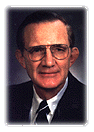
Curtis H. Barnette, Chairman |

Financial Highlights
 Business Units and Facilities
Financial Review and Operating Analysis
Financial Statements
Financial Notes
Report of Auditors and Management Statement
Five-Year Financial and Operating Summaries
Directors and Officers
Stockholder Information

Main Menu
Investor Relations
Business Units
Commercial Information
Environment
History
Vision Statement
Public Affairs
Research