

|
 |

BethStar Characteristics
Four grades, in a wide range of thicknesses, make a precise spec a simple matter
Low carbon and sulfur provide improved formability, weldability and toughness — reducing costs in processing
Higher strength/cost ratios deliver lower applied costs
1. Thicknesses 3�16 in. to 1�4 in. are available on an inquiry basis.
2. Composition values shown are maximums. BethStar plates may be ordered to more restrictive sulfur levels at additional cost.
3. Carbon equivalent values are used to compare relative ease of welding. The tabulated values correspond with the typical range most commonly used for plates produced by Bethlehem. The commonly used IIW C.E. is based on the empirical equation:
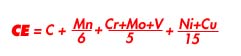
For steels with lower carbon contents, the Pcm equation has been found to be a better representative of the contribution of chemical composition, where:

4. For grades 50, 60 and 70, no preheat is required for temperatures above 0�F, provided low hydrogen conditions are maintained. For grade 80, at temperatures below 32�F, base metal should be heated to at least 70�F.
5. More restrictive CVN values are available on an inquiry basis at additional cost.
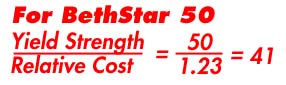
6. Relative costs are based on A36 steel plate, 3�4 in. x 96 in. x 240 in. = 1, and are expressed as a ratio.
7. 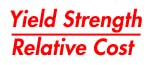
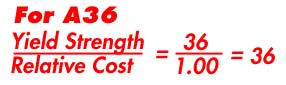
Relates cost of minimum yield in ksi of various grades. The higher the number, the more
advantageous to the designer. Example:
Burns Harbor  Burns Harbor Products
BethStar Steel Plate |
Home  Financial About Divisions Steel Links Products Markets What's New
E-mail comments to: [email protected]
�1998, Bethlehem Steel Corporation