|
 |

BethStar 80
BethStar 80 plate has 80 ksi minimum yield strength and is available through 3�4 in. thickness. Its outstanding strength/cost ratio, toughness, and ease of fabrication have made it the choice of designers for a wide variety of structural components. Applications include rough terrain crane booms and outriggers, off-highway hauler dump bodies and canopies, roll-over structures and on-highway trailer frames.
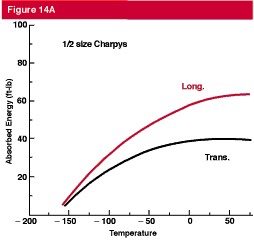
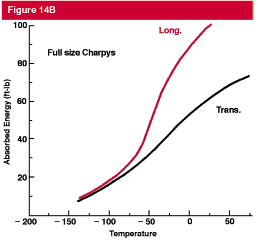
The excellent notch toughness of BethStar 80 is shown in Figures 14A and 14B. These plates exhibit excellent fracture appearance, as well as high-energy values at sub-zero temperatures. They may be ordered to ASTM A656, Type 7 specification.
Fatigue Properties
Strain-cycle fatigue tests were conducted on specimens machined from a 1�4-in.-thick
plate. The testing was conducted according to ASTM E606-80, “Recommended Practice for
Constant Amplitude Low-Cycle Fatigue Testing.” Test specimens were prepared with a
0.15 in. square reduced section and a surface finish of 16 rms. The results, Figs. 15 and
16, are typical of fatigue properties for other steels with a tensile strength of about
100 ksi.The properties and parameters determined for the cyclic stress-strain curve and
cyclic strain-life relationship can be used to calculate fatigue performance for various
notched conditions. Further details on this approach can be found in “Fatigue Under
Complex Loading,” Advances in Engineering, Vol. 6, published by SAE, Inc., 1977,
Warrendale, PA.
Welding Suggestions
BethStar 80 plate is readily weldable using the conventional arc welding
processes as reflected by its low-carbon and sulfur contents. Normally, no preheat will be
necessary; however, when the base metal temperature is below 32�F, the base metal should
be preheated to at least 70�F, and this minimum temperature maintained during welding.
Representative Mechanical Properties*
Thick |
Avg. |
Avg. |
Avg. |
Charpy |
Avg. |
Avg. |
3/16 |
90.1 |
100.8 |
18.9 |
1/3 |
22.5 |
27.6 |
1/4 |
87.5 |
98.1 |
19.2 |
1/2 |
38.6 |
48.3 |
3/8 |
86.9 |
99.0 |
18.2 |
3/4 |
41.2 |
73.0 |
1/2 |
90.4 |
102.4 |
17.8 |
Full |
36.9 |
92.2 |
5/8 |
86.7 |
98.6 |
18.7 |
Full |
38.2 |
73.5 |
*Based on minimum of 500 plates tested
Consumables:
Manual-Shielded Metal-Arc Welding. Any low-hydrogen (EXXX15, 16 or 18)
electrode of the E100 strength level or above will give adequate strength. If notch
toughness is a prime requirement, E10018M can be used. The American Welding Society’s
“Specification for Low-Alloy Steel Covered Arc-Welding Electrodes,” AWS A5.5-69,
discusses these electrode classifications.Submerged Arc Welding. The AWS booklet,
“Specification for Base Low-Alloy Steel Electrode and Fluxes for Submerged Arc
Welding,” A5.23-76, prescribes requirements for electrode/flux combinations for
submerged arc welding. While many electrodes falling under the general classification and
F10X-EXXX will provide welds with adequate strength, more detailed specifications are
necessary if impact properties are required (for example, Linde 95 wire + 709-5 flux will
conform to AWS grade F106-EM2-M2, which specifies 20 ft-lbs at -60�F).
Gas Metal-Arc Welding. AWS publication, “Specification for Low-Alloy Steel Filler Metals for Gas-Shielded-Arc Welding,” AWS A5.28-79, gives requirements for GMAW electrodes. An electrode meeting AWS specification ER100S-1 will provide weld metal strength and toughness sufficient for this grade.
Flux-Cored Arc Welding. An electrode meeting AWS A5.29 specification E100T1-K3 or E100T1-K5 will provide adequate strength and toughness for this grade.
Welding Procedural Testing:
For production applications where strength and toughness are critical, weld procedural
tests should be made to simulate actual joints.Procedure plates have been welded on 1�4
in. and 1�2 in. plates at heat inputs of nominally 35 and 50 kJ/in. Tensile and bend
results have been satisfactory. Figure 17* is a comparison of impact properties in the
weld metal, the weld heat-affected zone (HAZ), and the base materials. As shown, an
excellent balance of toughness is maintained across the welded joint. Hardness traverses,
as shown in Figures 18* and 19*, made on the 1�4 in. and 1�2 in. plates, show good
uniformity across the welded joint.