| Suggestions and Details for Bridges Corrosion Control Study
Studies have indicated the most important factor leading to excessive corrosion is the
runoff of water contaminated with deicing salts through leaking deck seals, expansion dams
or open joints. To minimize this problem the following should be considered.
Eliminate joints whenever possible. Jointless bridges up to 400' in length have been
used successfully. Such designs incorporate integral abutments with piling flexible enough
to accommodate girder translations. Bridges up to 1600' in length, with joints only at the
abutments, have likewise performed successfully. The combination of Weathering Steel and
jointless or minimum joint decks offers owners structures of long-term durability and
low-maintenance cost.
Use troughs beneath open finger-type joints as part of a system to discharge runoff
away from the superstructure elements.
Seal all other joints. Neoprene compression seals are commonly used in this
application. However, experience indicates many of these do leak over time due to traffic
and bridge movements.
Recognize the potential for leakage through sealed joints and overflow from blocked
troughs. Provide a second line of defense by coating the girders beneath deck joints.
Typical distances for this partial painting are l-1-1/2 times the girder depth on either
side of the joint.
Control roadway drainage. Minimize scuppers in order to maximize flow through them and
prevent blockage. Divert approach roadway drainage away from the bridge structure. Provide
adequate drainage beneath overpass structures to prevent bonding and continual traffic
spray from below.
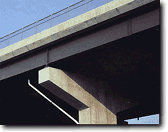
Another factor important to the successful performance of Weathering Steel structures
is the elimination of any details that prevent normal wet-dry cycles. The retention of
water, dirt and other debris must be avoided. All details should be designed to take
advantage of natural drainage. Tubular and box sections should either by sealed or
adequately vented to allow air circulation to prevent condensation and to allow drainage.
Weathering Steel, like most steel compositions, releases dissolved iron when water
washes or drains over exposed surfaces. The precipitation of the dissolved iron can cause
staining on adjacent surfaces, particularly when the steel is subjected to frequent
rainfall during the early months of exposure. If these surfaces are light in color and/or
porous in nature, this staining may be objectionable. Although this staining potential
usually decreases as the steel weathers and the tight protective oxide is formed, it may
be present for several years or an indefinite period, depending on variable environmental
factors.
The best way to minimize staining is to incorporate permanent design details that will
divert runoff water away from adjacent vulnerable materials. In bridge construction, the
most severe staining condition occur prior to the placement of the deck. Designers have
used a number of details, and in some cases various combinations, to cope with the
staining condition. Temporary polyethylene coverings, gutter and downspout systems,
adequate overhangs, drip plates, special flashing, and similar provisions will usually do
the job.
Another method to reduce stain penetration is to apply liquid silicon or other type
sealers to porous masonry. Some surface discoloration still may occur, but, in some
applications, may not be objectionable. Also, it has been claimed that these
"stained" sealed coatings will fade and weather-off with time. If this
protective measures does not prove adequate, staining can be removed by using proprietary
chemical stain removers or, if necessary and applicable, sandblast cleaning. Caution
should be exercised in using stain removers; manufacturer's recommendations should be
obtained and followed.
The following is a summary of methods designers have used to minimize staining:
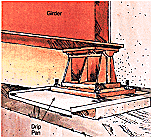 |
Drip Pans
In several installations, pans made from steel or fiberglass have been placed under the
bearings and cantilevered out from the pier. These pans direct the rust-laden water away
from the piers to a location which will not cause major staining. Where the piers are very
high, however this system may permit the wind to blow rust-laden water back to the pier
surface. |
|
|
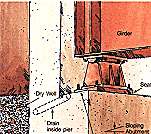 |
Sloping Abutments, Pier Details and Drains
Various combinations of sloping and concave surfaces used on abutments and piers in
conjunction with drains provide an economical method of minimizing staining. The
rust-laden runoff water is directed to areas which are not readily visible. Drains then
collect this water and carry it away. |
|
|
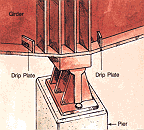 |
Drip Plates
A small plate attached to the bottom flange of a girder can divert water off the structure
before it runs onto another bridge component. |
|
|
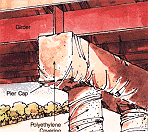 |
Polyethylene Covering
One method to minimize staining prior to deck placement is to cover the pier caps with a
polyethylene sheet until the bridge deck has been poured. Be sure to provide an effective
wrapping which will not be easily damaged by wind gusts and construction operations. Once
the deck is to place and a system installed to carry away the rust-laden water, the
plastic sheets can be removed. In several instances, this technique has been used
successfully in combination with pier coatings. |
|
|
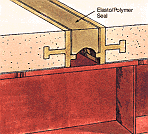 |
Preformed Elastomeric Compression Joints
Preformed elastomeric compression joints, when installed and functioning properly, provide
a thorough seal against deck surface water. These joints help prevent water from draining
through and staining the substructure surfaces. |
Pier Coatings
To reduce penetration by rust stain, liquid silicon sealers or other formulations can be
applied to porous materials such as brick, stone, and concrete. Designers using this
method of protection must understand that the pier in some cases will be discolored by the
treatment. Although the coating reduces penetration of the stain, some surface
discoloration may be noticeable because of oxide deposits. Coatings may break down and
disappear with time, thus allowing the piers to develop a natural color.
Cleanup
Staining is not a new problem nor is it unique to Weathering Steel. It is a characteristic
of all structural materials. If all preventive measures fail, the stained areas can still
be cleaned either by sand-blasting or by using one of several proprietary chemical stain
removers.
Summary
Staining is most severe when Weathering Steel is subjected to prolonged rainfall during
early months of exposure. That is when protection against staining is most important.
Nightly condensation is the best aging agent available and does not usually result in
significant staining.
Inspection and Maintenance
Effective inspection and maintenance programs are essential to the successful performance
of all structures, not just those built with Weathering Steel. Particular attention should
be given to those drainage systems on and beneath the structure and its approaches.
Troughs must be kept open and sealed joints resealed. Debris and salt deposits should be
periodically flushed from the structure itself, particularly beneath joints and around the
bearings. Vegetation should be cleared from pier and abutment areas to enhance air
circulation and the subsequent weathering of the steel.
Fatigue
The issue of fatigue life of uncoated Weathering Steel has been addressed by the AASHTO
Subcommittee on Bridges and Structures. The Subcommittee concluded that Weathering Steel
can be considered the equivalent of painted steels in evaluating fatigue life for all
AASHTO stress categories except Category A. The allowable stress ranges for Weathering
Steel Category A details are noted separately by AASHTO in the current specification.
Category A is essentially the base metal in either a rolled section or a plate. This is
the area of the highest allowable ranges and typically does not control the design of a
member.
Weathering Steel Main Page
|