|


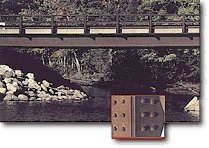
| The Weathering Process Alloy content and environmental conditions are the main factors influencing the formation of an oxide film on steel. Weathering Steel develops a durable, tightly adherent protective oxide coating under appropriate atmospheric conditions. The appearance, texture, and maturity of this oxide coating depend on three primary interrelated, natural factors: time, degree of exposure and atmospheric environment. With passage of time, the oxide coating changes from a "rusty" red-orange to a dark, rich, purple-brown patina. The moderately rough texture becomes more distinct as the coating thickens. This weathering process extends over a period of time depending upon these "natural factors."
Degree of exposure has a strong influence on the weathering process. Steel boldly exposed to rain, sun , and wind will weather more quickly than steel in a sheltered location. Also, on sheltered surfaces, the oxide tends to be rougher, somewhat less dense and less uniform. Atmospheric environment also plays an important part with respect to oxide development. Frequent wet-dry cycles-moisture in the form of rainfall and dew and drying by wind and sun-are the key to the weathering process. Degree of contamination of the atmosphere also has its effect. In moderate industrial environments. Weathering Steel usually matures most rapidly and achieves the darkest tone. In rural locations, the protective oxide coating develops more slowly and generally has a lighter tone. In arid climates, the weathering process is quite slow. There are environments where Weathering Steel is not recommended in a bare, uncoated condition because the protective, tight oxide will not form properly. These are:
In addition, questions have been raised regarding the effect of acid rain on the corrosion resistance of uncoated weathering steel. Research conducted by Bethlehem indicates that the effect of acid rain can be ignored . Wet deposition of sulfur dioxide, as in acid rain, actually has a beneficial effect on weathering steel. This is believed to be due to the fact that acid rain washes away dry deposits of sulfur which can increase corrosion. When compared to the major corrosion causing atmospheres listed above, acid rain is of no consequence. Similarly, concerns regarding the effects of diesel engine exhaust gases on overhead uncoated weathering steel structures have been expressed. An industry-sponsored study concluded that the corrosive effect of these gases on uncoated structures was negligible. This conclusion was based on the fact that the combustion products of diesel fuel, together with steam, are dissipated to the atmosphere. Only soot, unburned fuel and its decomposition products could be deposited on the steel. These have been shown to be non-corrosive toward steel. The FHWA has issued a technical advisory entitled "Uncoated Weathering Steel Structures" which provides the latest and most complete information available concerning the proper application of Weathering Steel in highway structures. With FHWA permission. Bethlehem has reprinted this advisory as Technical Bulletin TB-307, which is available upon request. The principles in this advisory and those above apply not only to bridges but to all structures, including light, sign and electrical distribution poles and structures. A more precise technical evaluation of the suitability of uncoated Weathering Steel for a particular site may be obtained from a corrosion consultant, from conducting standardized environmental tests, or from both.
In summary, Bethlehem has evaluated long-term tests of Weathering Steel in a variety of atmospheric environments. The technical aspects and most pertinent results of these tests are illustrated in the graph above. In the past, a general conclusion regarding the long-term exposure testing of Weathering Steels is that these grades of steel have atmospheric corrosion resistance of approximately two times that of carbon structural steel with copper. Two times carbon structural steel with copper is equivalent to about four times carbon structural steel without copper (copper 0.02 max.) ASTM now provides a standard guide (G101) describing more meaningful methods for estimating the atmospheric corrosion resistance of low-alloy weathering steels. This guide provides for estimation of relative corrosion resistance on the basis of chemical composition or alternative prediction of long-term performance on the basis of short-term data.
|

Bethlehem Lukens Plate Products
If you have any questions or comments, please Contact Us
�1998, Bethlehem Steel Corporation