XF Series Hot-Rolled Sheet (pg. 3)
Bethlehem Hot-Rolled XF Sheet Steels have a low carbon equivalent, making them easily weldable, while low sulfur content gives improved weld toughness.
Weldability of the XF Steels
The XF steels were designed to have low carbon equivalents and have excellent weldability when using most arc and resistance methods employed for sheet steels. Carbon and sulfur are controlled to low levels in these steels, resulting in superior weldability as compared to other conventional high-strength steels.
Resistance Spot Welding
The spot weldability of a steel is characterized by peel and weld tensile tests. The spot welding lobe (Figure 6), as determined from peel tests, indicates that the B80XF steel can be welded over a wide range of conditions and produce acceptable weld sizes without expulsion. Current levels for the high-strength steels are somewhat lower than those required for plain carbon steels, and electrode forces are slightly higher to compensate for greater springback.
Tensile shear properties (Figure 7) follow the same trends of other high-strength steels:
TSS = F x D x UTS x TK
where TSS is the weld tensile shear strength, F is a constant, D is the weld diameter, UTS is the base metal ultimate tensile strength, and TK is the thickness. For the English system, the units of the above equation become:
kip = 2.6 x in. x ksi x in.
and for the metric system:
kN = 0.0026 x mm x MPa x mm
Arc Welding
The requirements for low hardenability result in steels that have very low carbon equivalents and, therefore, good arc weldability.
Hot-rolled XF steels can be arc welded using the same processes employed for plain carbon steels but with higher strength electrodes. The 70-class low hydrogen electrodes are satisfactory for the B50XF grade, while 100�class, low hydrogen electrodes can be used for the B80XF grade. Full 100% joint efficiency is readily obtainable with the XF steels.
The low sulfur of these steels is beneficial for applications requiring superior impact toughness in arc welds. The impact toughness of typical B80XF welds is given in Figure 8. For example, one user requires an energy absorption of 6 ft-lb (8J) at -20�F (-29�C) for critical applications. The B80XF meets these severe requirements.
No preheat is necessary or desirable when arc welding any of these high-strength sheet grades unless moisture is present. Their extremely low carbon equivalents
eliminate hydrogen cracking problems.
|
|
| Charpy V-notch properties from GMAW welds in B80XF tested from -60�F (-51�C) to +80�F (21�C) with 0.125 inch (3.18 mm) specimens. Welds were performed with 250 A, 31 inch/min. (79 cm/min.) travel speed, 0.035 inch (0.89 mm) diameter wire, and CO2 shielding gas. |
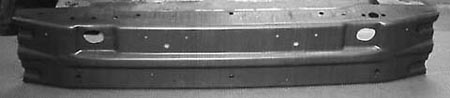
Bumper Reinforcement B80XF |
XF Series (pg. 1) XF Series (pg. 2) XF Series (pg. 3)
XF Series (pg. 4) XF Series (pg. 5)



