|
|

| |

XF Series Hot-Rolled Sheet (pg. 1)
Click here to print PDF file
Bethlehem's XF Series steels offer a cost-effective combination of strength, formability and weldability to help you improve your product.
Strength
The XF Series includes grades with minimum yield strengths of 50, 60, 70, and 80 ksi to meet the needs of your design.
Mechanical Properties
| Grade |
Yield Strength 0.2% Offset, ksi (MPa) |
Tensile Strength ksi (MPa) |
Total Elongation, 2 in. |
Uniform Elongation, 2 in. |
Hardness HRB |
Minimum Hard Way Bend Radius2, t |
B50XF
Minimum
Typical |
50.0 (345)
57.0 (393) |
60.0 (414)
69.0 (476) |
24%
26% |
-
15% |
-
80 |
1/2
0 |
B60XF
Minimum
Typical |
60.0 (414)
66.0 (455) |
70.0 (483)
79.0 (545) |
22%
25% |
-
14% |
-
85 |
1/2
0 |
B70XF
Minimum
Typical |
70.0 (483)
77.0 (531) |
80.0 (552)
89.0 (614) |
20%
23% |
-
13% |
-
90 |
3/4
1/4 |
B80XF
Minimum
Typical |
80.0 (552)
86.0 (593) |
90.0 (621)
97.0 (669) |
18%
21% |
-
12.5% |
-
94 |
3/4
1/4 |
1. Values shown are for thicknesses 0.097 in. (2.46mm) and thicker. Total elongation minimum is 2% less for thicknesses 0.071 in. (1.80mm)
to 0.096 in. (2.44mm).
2. t equals the sheet steel thickness.
Formability
Since they are HSLA steels, the XF Series grades are already easier to form than conventional carbon-manganese grades. Adding the sulfide inclusion control feature gives an extra measure of formability for parts that are difficult to make using conventional HSLA. An indication of this improved formability is shown in the following tables:
Forming Parameters1
| Steel Grade |
Plastic Strain Ratio, rm |
Strain Hardening Exponent, n |
FLD20, % |
LDH3 in. (mm) |
Olsen Cup in. (mm) |
Hole Expansion % |
Minimum 180� Bend Radius4 t |
Stretch-Bend (r/t=3)5 in. (mm) |
DQ
B50XK |
0.92
0.90 |
0.19
0.13 |
47.0
34.0 |
1.28 (32.5)
1.07 (27.2) |
0.60 (15.2)
0.56 (14.2) |
84
59 |
0
1-1/4 |
1.18 (30.0)
0.86 (21.8) |
| B50XF |
0.83
0.83 |
0.16
0.14 |
48.0
34.0 |
1.13 (28.7)
0.96 (24.4) |
0.58 (14.7)
0.54 (13.7) |
86
58 |
0
1/4 |
0.99 (25.2)
0.84 (21.3) |
1. Data from single sample tests.
2. Forming limit diagram at 0% minor strain.
3. Limiting dome height at 0% minor strain.
4. t equals the sheet steel thickness.
5. Bend radius to thickness ratio.
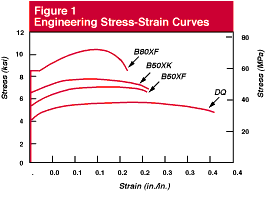 |
An engineering stress-strain curve for the four grades (Fig. 1), as well as forming limit diagrams for B50XF (Fig. 2) and B80XF (Fig. 3), are shown to assist in making preliminary judgments on design. |
XF Series (pg. 1) XF Series (pg. 2) XF Series (pg. 3)
XF Series (pg. 4) XF Series (pg. 5)
|
|

