
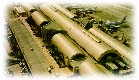
 Click above for a larger version (35K - approximate download time 30 seconds) |
Curved prepainted Galvalume� sheet panels top airport's terminal buildings.Rapid population growth together with even faster aircraft traffic growth required expanded facilities at the John Wayne Airport, Orange County, California. Originally built in the 1960's, the airport needed a tenfold increase in the size of the terminal (337,900 sq ft vs. 29,000 sq ft) and an expansion to 14 aircraft gates. The building is located in a highly visible area. Its orientation and the runway layout forced a long, narrow footprint. The design team, however, turned the awkward shape into an advantage with a plan that both minimizes the distance through the terminal and maximizes the flow of space inside the terminal. From both outside and inside, the new John Wayne Airport Terminal Buildings achieve a dramatic effect with a barrel-type roof design. From the air, the shiny curved metal roof resembles an aircraft fuselage. And from the interior, the high, arched roof frames provide a sense of openness and generous space for travellers moving about within the building. Key requirements: Aesthetics and long-term durabilityThe selection of a barrel-type roof style was established from the very beginning of concept development. And metal was the clear choice for the roofing material. Several different metal roofing systems were considered, but the final decision was based on the system that could provide the desired aesthetics, had a proven record in terms of corrosion resistance and long-term durability and would fit within the desired building budget. AEP/SPAN's HS-20 roofing panel system fabricated of Bethlehem's prepainted Galvalume sheet steel was determined to provide the best overall solution. Prepainted Galvalume sheet is available in a wide range of colors and finishes providing designers many options from which to choose. The prepainted Galvalume sheet roofing panels were shipped to the site from AEP/SPAN's plant in Dallas, Texas, in lengths ranging from 30 to 40 ft. At the same time, approximately 600 flat prepainted Galvalume sheets, measuring 48 in. by 120 in., were shipped to GSM Sheet Metal for fabricating gutters, downspouts, gutter closures, flashings and other miscellaneous trim. Altogether, some 240,000 sq ft of prepainted Galvalume sheet were required for the project. The architects specified AEP/SPAN's High Seam HS-20, .023-in. prepainted Galvalume sheet panel prefinished with a "Champagne Gold" fluorocarbon paint system. With a pan width of 20 inches and seam height of 1-1/2 inches, the HS-20 panel is particularly applicable for curved applications. The panel system features a thin standing seam rib with very strong positive interlocking clips. The clips join the panels which are then attached to the substrate with concealed fasteners. Panel curvatures formed at jobsiteAll of the roofing panels were formed to a 22-ft, 40-ft and 30-ft radii with AEP/SPAN's jobsite curving machines. As the panels were formed, they were carried by roof mechanics up a temporary aluminum stairway to the installation crews on the roof. As each panel was laid, it was shimmed to provide a true curvilinear shape. Galvalume is a registered trademark of BIEC International, Inc. The substrate consists of rolled structural steel tubes with rolled deck to fit the various radii. Additionally, the substrate included a 3-inch layer of insulation and 2-1/2 inches of lightweight concrete. The prepainted Galvalume roof panels are attached to 5-1/2-inch-deep Zee runners located every 24 inches in the insulation and lightweight concrete. Each prepainted roofing panel was inspected for scratches, and curving distortions before it was laid. Since the panels are interlocking, they cannot be removed once they are locked in place. Normally, a 30-lb felt would be used to isolate the prepainted Galvalume roof panel from the lightweight concrete. In this instance, however, the general contractor substituted three separate layers of underlayment consisting of a roofing base sheet, topped by a reinforcement fabric which was then covered with rubber membrane. This extra precaution was taken to make sure that work inside the air terminal buildings could continue without concern for water damage prior to completion of the roofing system installation. AEP/SPAN's HS-20 panels have interior gaskets to insure against water penetration once they are locked in place. Stringent paint process specificationsBethlehem's process specification program insures that the prepainted Galvalume sheet used to produce AEP/SPAN's High-Seam HS-20 panel is manufactured to prescribed high-performance standards. The program specifies methods and materials to be used in each phase of the painting process. Chromate pretreatment provides a superior combination of flexibility and corrosion resistance compared to other types of pretreatments, like zinc phosphate or complex oxide typically used for painted galvanized sheet. Prepainted Galvalume is also less susceptible to micro-crazing and loss of paint adhesion during forming, such as that done at the John Wayne Airport job site. Rigorous laboratory and atmospheric exposure tests are conducted to ensure that the primers used on prepainted Galvalume sheet will provide excellent sheared edge paint adhesion and corrosion resistance in addition to superior long-term performance at flat, formed and paint-damaged areas. |

