Philosophy
We are committed to the safety and health of our employees. We must judge our actions and results by the best industry has to offer.
Our Vision:
- Have the best safety and health performance in industry and be the industry leader in achieving safety and health excellence.
- Jointly manage safety and health as an ongoing process.
- Create a work environment that fosters union/management participation and employee empowerment.
We Believe:
- Safety is a fundamental value, shared by each employee. It will not be compromised.
- All accidents, injuries and work-related illnesses can be prevented. Every job we do must be done safely.
- Safety is a shared responsibility, and every employee must be a partner in providing safe work practices and conditions.
- Nothing is more important than safety. Excellence in safety, quality and productivity must be one measure of a successful organization.
- All levels of the organization must manage safety as they manage productivity, quality and cost and be held accountable for their performance.
Developed by the Safety and Workers' Compensation Process Improvement Team, 1994.
Employee Safety Process
The major emphasis of our safety effort continues to be our Employee Safety Process (ESP). More than 10,000 employees have received ESP awareness training at our business units. ESP, developed in partnership with employees, union and management, is the largest undertaking of its kind by Bethlehem.
Training, which has introduced the use of ESP tools in all production and maintenance units, focuses on several processes for implementing ESP:
DO-IT is an acronym for Define, Observe, Intervene and Test: Define areas of safety concern; observe to gather data for analysis of root causes of situations of concern; intervene to improve performance; and test to confirm the results.
Intervention provides timely, well-meaning, constructive feedback that reinforces safety awareness. Intervention is synonymous with coaching (positive feedback), which reinforces or modifies safe behaviors and corrects at-risk conditions. Coaching has its own acronym - COACH - which stands for Care, Observe, Analyze, Communicate and Help.
SMART is an acronym for Specific, Motivational, Achievable, Recordable and Trackable: Specific - pinpoint or focus on safety goals; Motivational - goals should encourage participation in the safety effort; Achievable - goals should reinforce success; Recordable - goals should be visible for everyone to see; and Trackable - everyone should be able to follow the progress of achieving the goals.
Safety Performance
Bethlehem's 1998 safety and health performance was the best ever in the history of the corporation. Three standard statistical measurements for injury and illness incidence rate [all-injuries, lost-workday (LWD) cases and recordable incidence cases] continued a downward trend that began in 1994 (see chart at right). Despite fewer reported injuries and lower incidence rates, we had three fatal incidents in 1998. We deeply regret the loss of these employees and extend our condolences to their families, friends and co-workers.
The Subsidiary Railroads continued to lead all business divisions in 1998 in all three statistical categories, bettering its 1997 performance in each category. Burns Harbor continued to lead the steelmaking business divisions in overall safety performance, and it was the only division to lower its injury rates from 1997 in all three reporting categories. Burns Harbor employees achieved record-low incident rates for the fourth consecutive year, working 72 injury-free days in 1998, up from 55 in 1997.
Safety performance for the first six months of 1999 compared to 1998 showed further improvements in all three case rate categories - lost workdays (21 percent), all-injury (10 percent), and recordable (9 percent).
Areas of Excellence
Three departments at Burns Harbor logged more than one million man-hours (considered an industry benchmark) without a lost workday: Service Shops & Technical Maintenance, Quality & Process Technology, and the Cold Sheet Mill Pickler. The latter was over five years.
PST worked more than one million man-hours without a lost workday from December 1998 to May 1999 and its Maintenance Services Department had no LWD cases through mid-1999.
Also, through mid-1999, Lackawanna Galvanized had no LWD cases. Lackawanna Coke By-Products was injury-free and Coke Electrical Maintenance has had no LWD cases since September 1996.
Sparrows Point's Cold Sheet Mill and Bethlehem Lukens Plate-West, located in Burns Harbor, reduced injuries by 50 percent in 1999 versus 1998.
Chairman's Award for Safety Excellence
The Burns Harbor Coke Ovens, Sparrows Point Roll Shop and Subsidiary Railroad Companies each received a Chairman's Award for Safety Excellence. The award recognizes significant contributions toward achieving the corporate Vision to Be the Premier Steel Company.
Burns Harbor Coke Oven department employees were recognized for their improved and sustained safety performance in a very challenging work environment through an effective union-management partnership.
|
Burns Harbor Coke Ovens was honored with the Chairman's Award for its improved and sustained safety performance. From left to right, Roger Penny, Walt Bargeron, Hank Barnette, Larry Mayton, Andy Hopkins and John Mobery.
|
|
|
Sparrows Point Roll Shop employees were recognized for their safety team's use of ESP observation and coaching tools to improve workplace conditions and behaviors. The Roll Shop is the first steel plant department to have a "zero" lost workday rate.
Employees from the Sparrows Point Roll Shop received the Chairman's Award
for Safety Excellence for having achieved zero lost workdays.
The Bethlehem Subsidiary Railroad Companies received a Chairman's Award for Safety Excellence for the second consecutive year. The Railroads produced the best injury-incidence rates and the most improved incidence rates corporate wide. Two Subsidiary Railroad companies - the Philadelphia, Bethlehem & New England Railroad and Conamaugh & Black Lick Railroad - achieved no injuries for 1998. The Railroads had only one lost workday injury in 1998 and worked six months without an injury.
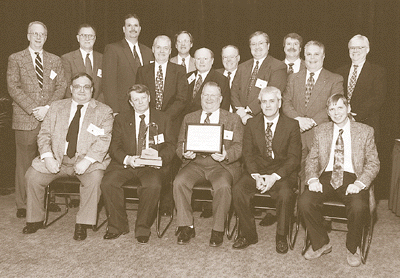
Representatives from Bethlehem's subsidiary railroads received
their second consecutive Chairman's Award for Safety Excellence
for outstanding performance.
Audits
Bethlehem conducted a compliance review of the PST lockout/tagout program. Major revisions to the program were begun in 1998.
Audits of electrical-related work practices were conducted at Sparrows Point, PST and Bethlehem Lukens Plate-Conshohocken by Duke Power Engineering Services. Internal reviews were conducted at all other facilities.
Regulatory Activity
The Occupational Safety and Health Administration conducted seven inspections at Bethlehem facilities in 1998, three at Burns Harbor, two at PST and one each at Sparrows Point and Bethlehem Lukens Plate-Conshohocken.
No major enforcement-action penalties were levied in 1998. Bethlehem did, however, reach an agreement with OSHA to settle citations received by the former Lukens Steel Company in 1997 at the Coatesville facility, prior to the formation of Bethlehem Lukens Plate. The settlement, which was submitted to an administrative law judge for approval, included a penalty of $180,000.
Bethlehem paid $13,410 in penalties in 1998 related to safety and health activities; a 95-percent reduction in comparison to 1997 penalties.
Safety, Health and Environment Department
1170 Eighth Avenue, Martin Tower, 12th Floor, Bethlehem, PA 18016-7699.
For further information, send mail to [email protected]
1998/99 Environmental Report Table of Contents


