Click here to print PDF file
 Building survey demonstrates the superior corrosion resistance of prepainted Galvalume sheet roofing in acid-rain environments
Paint blistering and red rusting is minimized along roof drip edges compared to prepainted galvanized sheet.
pH and Acid Rain The term pH is used to indicate the degree of acidity of solutions on a scale of 0-14. A pH of 7.0 is considered a neutral solution. Values below 7.0 are considered acidic, while those above 7.0 are basic.
pH values are commonly used to measure the relative acidity of solutions, including rainfall. Theoretically, a pH value of 5.6 results from the normal combination of pure water and atmospheric carbon dioxide to form a weak carbonic acid solution(1). While acid rain is officially defined as precipitation with a pH of less than 5.6, some researchers think a more realistic value is 5.0. This is because even naturally occurring processes have been observed to result in precipitation with pH values of 4.8-5.0.
When man-made nitrogen and sulphur dioxide emissions are introduced into the atmosphere, the subsequent acid rainfall has been characterized by pH values down to 4.0 and even lower. This degree of acidity can result in corrosive damage to engineered structures.
Prepainted Roof Performance Survey In the more aggressive acid-rain areas of the U.S., corrosive attack is particularly severe on the drip edges of prepainted metal roofs. The drip edges are exposed to two conditions which tend to accelerate this corrosion: (1) the natural erosion by water as it drains off the roof, and (2) the corrosive attack of the water made more aggressive by the airborne contaminants that produce acid rain.
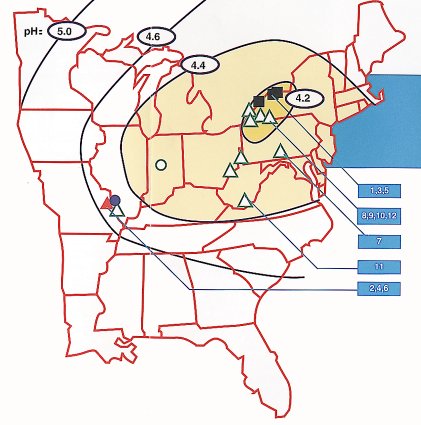 To evaluate the performance of prepainted metal roofing in such acid-rain areas, 23 buildings were inspected. Building locations are shown on the accompanying map, upon which pH contours have been superimposed. The pH values represent the average pH level measured(2) for 1983, a year which represents the approximate midpoint of the time frame in which the buildings were erected (1976-1989). The most severe acid-rain region is represented by the shaded area enclosed by the pH = 4.2 contour. Nine of the survey buildings are located in this region.
Many pretreatments and paint systems are represented in this study, as shown in the map legend. Filled symbols represent buildings with hot-dip galvanized (HDG) G90 roof substrates, while open symbols indicate the building roofs were constructed with Galvalume sheet substrates. The Galvalume sheet alloy coating is typically 55% aluminum, 1.6% silicon, and the balance zinc, nominal percentages by weight. Numbers 1 through 12, shown to the right of the map, identify the locations of buildings highlighted in the accompanying photographs. Most buildings represent construction with a 3:12 roof pitch, although the Galvalume buildings between about 4 and 8 years of age generally represent a lower pitch roof of about 1:12. For these lower pitch roof buildings, the water drainage would be expected to be slower, but the time of drip edge wetness after a rainfall would be longer, than for the steeper roofs.
Corrosion Measurements Two observable conditions reflect the corrosion occurring on the roof drip edges: (1) the degree of paint film blistering, or creepback, from the drip edge, and (2) the extent of red rust associated with corrosion of the base steel.
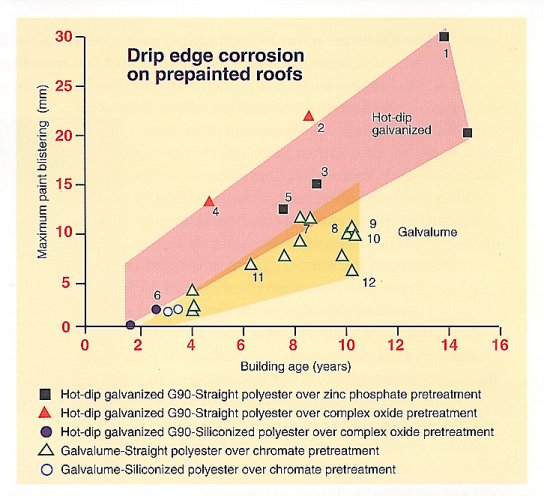
The degree of paint blistering is plotted as a function of building age on the graph. Each plotted value is representative of the maximum amount of paint blistering occurring repetitively along a particular building's drip edge. The superior performance of prepainted Galvalume sheet is shown by its distinctly lower data band in the graph. For prepainted Galvalume buildings up to 10 years of age, paint blistering ranges about 6-12 mm from the roof drip edge. For prepainted HDG G90 buildings, the degree of paint blistering is significantly greater, ranging approximately 12-22 mm after up to 9 years of age, and to a greater degree for older buildings.
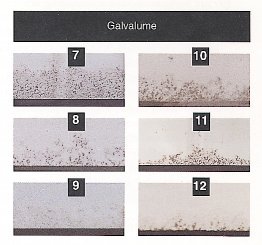
Of perhaps greater impact is the visual appearance of the building drip edges as clearly shown in the accompanying photographs. The key difference in appearance between the Galvalume and HDG roof materials is the amount of red rust on the HDG drip edges. Even on relatively new HDG buildings, such as buildings 4 and 6, some red rust is present. For the Galvalume sheet drip edges, virtually no red rust is exhibited.
Corrosion Mechanism The difference in the observed visual appearance reflects the difference in corrosion mechanism between HDG and Galvalume sheet. Once the paint film has begun to blister or creep away from the drip edge, the protection of the base steel becomes a function of the durability of the metallic coating. The pure zinc coating of HDG corrodes uniformly as a result of general water erosion and acid-rain attack. When the zinc is consumed a distance from the drip edge, galvanic protection is eliminated and red rusting of the base steel begins. This cycle continues to repeat with time: paint blistering increasingly occurs, additional zinc is exposed and corroded away, less galvanic protection is provided and red rusting of the base steel progresses up from the drip edge.
By contrast, the 55% Al-Zn coating on Galvalume sheet corrodes at a much slower rate than pure zinc, resulting in superior protection of the roof drip edge. Thus, even after the paint film has blistered, protection against red rust is extended because the exposed 55% Al-Zn coating remains on the steel sheet significantly longer than a pure zinc coating. This performance is consistent with accelerated laboratory test results(3) in a simulated industrial environment (Kesternich test) and outdoor performance data from building surveys(4-5) on bare Galvalume roofs located in various parts of the United States, including acid-rain regions.
Summary Based on a building survey conducted in the acid-rain region of the United States, prepainted Galvalume roofs exhibit significantly less drip edge corrosion compared to prepainted HDG G90 roofs. This performance is related to the superior long-term corrosion resistance of the Galvalume substrate.
References
- M.E. Peden and J. E. Rothert, "Acid Rain - A Historical Look", ASTM Standardization News, ASTM, pp 42-45 (1987).
- 1984 Annual Report to Congress and the President, National Acid Precipitation Assessment Program, cited in reference 1, above.
- N.S. Berke and H. E. Townsend, "Comparison of the Kesternich Sulfur Dioxide Test with Industrial Atmospheric Corrosion Tests of Zinc-, Aluminum-, and Al-Zn- coated Steel Sheet", Journal of Testing and Evaluation, JTEVA, Vol 13, No. 1, pp 74-76 (January 1985).
- W. D. Barker and A. R. Borzillo, "Field Study: Standing Seam Holding Up Well", RSI, pp 30-32 (December 1988).
- H. E. Townsend, A. R. Borzillo and W. D. Barker, "Performance of Al-Zn Alloy-Coated Sheet after Twenty-Two Years of Atmospheric Corrosion Testing", Proceedings of the International Galvanizing Conference, Rome, pp SA1/1-11 (June 1988).
More Information
If you would like additional information, contact your prepainted Galvalume panel manufacturer, or call one of Bethlehem's Product Applications Engineers at 1-800-521-4789.
Galvalume� is a trademark of BIEC International, Inc.
PR 600
Data current as of May 1992. Printed in U.S.A.
�1992 Bethlehem Steel Corp. All rights reserved.



