


Bethlehem’s High-Strength, Cold-Rolled Sheet
Introduction:
High-strength, cold-rolled steels are defined generally as having a yield strength greater
than 30 ksi (205MPa). The high strength levels are achieved through combinations of
alloying, rolling and annealing practices.
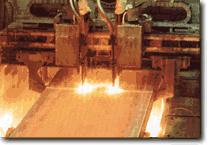
The development of our line of high-strength steels began in the 1970’s to meet the growing need for weight savings while maintaining many of the desirable properties of regular, mild carbon sheet steels. This development included the installation of the Continuous Heat Treating Line (CHTL) at Burns Harbor plant which is capable of producing sheet, called AccuFormtm, with exceptionally consistent properties. All of the high-strength grades are made by continuous casting, which contributes to the overall consistency of the steel.
Availability:
High-strength, cold-rolled steels are available from Bethlehem in a wide range of
widths and thicknesses in both coils and cut lengths. Bethlehem uses a code designation
for high-strength steels which allows easy identification of the various grades and
strength levels. The code consists of the letter B prefix to denote Bethlehem Steel, a
number to designate the minimum yield strength in ksi, and a two-or three-letter suffix to
describe the grade. The grade suffixes are listed below:
| S= | plain carbon, structural quality |
| P= | plain carbon, rephosphorized |
| R= | plain carbon, recovery annealed |
| BH= | bake-hardenable |
| X= | low alloy |
| K= | killed |
| F= | killed with inclusion control |
| DKL= | dual-phase |
 |
Yield strengths available range from 30 to 100 ksi (205 to 90 MPa), thicknesses from 0.018 inch (0.50mm) to 0.080 inch (2.00 mm) and widths from 24 inches (610mm) to 62 inches (1570mm). There are certain size restrictions within the ranges given depending on the grade and strength combination.
Where corrosion resistance is a consideration, many of our grades, strength levels and sizes can be supplied as coated sheet. These coatings include hot-dipped galvanized, EG� (electrogalvanized) and ZnNi EG� (an electroplated alloy comprised of zinc and nickel) sheet. The high temperatures necessary in a hot-dip operation may alter the mechanical properties of the base steel. The low-temperature electroplating process will not significantly change the substrate mechanical properties.
"EG" is a registered trademark of Bethlehem Steel Corporation
Performance Attributes
Formability:
The forming characteristics of a sheet steel can be generally related to three measured
mechanical properties: total elongation, strain hardening exponent and the plastic strain
ratio.
Total Elongation - A high total elongation is a general measure of good formability. For the most part, elongations become lower as the strength increases. This value correlates well with bend capacity, hole expansion, elongation of a blank edge and other forming operations.
Strain Hardening Exponent (n-value)-this property relates to the ability of a material to be stretch formed. The strain hardening exponent generally decreases with increasing strength.
Plastic Strain Ratio (r-value)-High values are associated with an increased capability to make deep-drawn parts and are a measure of the resistance to thinning of a sheet during forming. It is also important for hole expansion and elongation of a blank edge. High-strength steels generally have lower values than conventional batch-annealed, low-carbon steels.
Welding:
Although slight adjustments are required, high-strength steels can be readily welded with
conventional equipment. To obtain joints with equivalent strengths of the base steel,
high-strength are welding filler metals are necessary.
High-strength electrodes, higher electrode force, longer welding times and lower currents are required for resistance welds is proportional to the tensile strength of the sheet at a constant thickness and button diameter.
Fatigue:
High strength sheet steels have better fatigue resistance than mild steel at low stresses
over a large number of cycles. At high stresses with few cycles, the opposite is true
because lower strength steel accommodates the stress conditions through plastic
deformation. To avoid exaggerated fatigue effects at notches, the design should place
notches at low stress locations.
Dent Resistance:
Since dent resistance is positively correlated with yield strength, higher yield strength
steels will offer greater dent resistance at any given sheet thickness.
Energy Absorption:
Energy absorption increases with yield strength. High-strength steels are superior to both
mild steels and non-ferrous products in energy absorption.
Contact Us: email: [email protected]
Automotive Technical Bulletins
Home  Financial About Divisions Steel Links Products
Markets What's New
Financial About Divisions Steel Links Products
Markets What's New
E-mail comments to: [email protected]
�1998, Bethlehem Steel Corporation