


Cold-rolled and Electrogalvanized Bake-Hardenable Sheet Steels (B30BH)
Introduction:
Bake-hardenable sheet steels make up a relatively new class of sheet steel products that
offer both good formability during automotive press stamping operations and greater
resistance to denting due to door "dings", stone damage, or "palm
printing" in the final assembly. Since dent resistance is a function of both yield
strength and thickness, this greater resistance can be attained in several ways. For
example, the sheet steel thickness can be increased, but that move is contrary to present
design trends which strive for weight reduction. Using a steel modestly higher in yield
strength, e.g., 30 to 40 ksi (210 to 280 MPa; 45 to 55 kg/mm2), compared to
conventional, low-carbon sheet steels, can also provide inherently higher dent resistance
but may not provide the optimum in formability. A bake-hardenable sheet steel offers both
good formability in the incoming steel and a higher final yield strength in the finished
part as a consequence of the common automotive forming and paint-baking operations. The
forming operation imparts some degree of work (strain) hardening which increases yield
strength, and the paint-baking cycle provides another incremental increase due to
moderate-temperature (e.g., -1750C; - 3500F) (carbon) aging. Note,
however, that these aluminum-killed sheet steels are resistant to room temperature aging
prior to forming. No return of yield point has been observed for aging times up to one
year. Furthermore, the tensile strength of bake-hardenable sheet steels remains
essentially unchanged.

The availability of a high final yield strength in bake-hardenable sheet steels gives the automotive engineer the option of selecting a design that capitalizes on good formability and yet provides improved dent resistance and/or weight and cost reduction benefits. The decrease in weight available through using thinner sheet that still provides the necessary strength can offer improved fuel economy to help meet tightening CAF� requirements and more demanding vehicle emission restrictions. Bethlehem’s "B30Bh" is an example of a continuously-annealed, bake-hardenable grade. This particular code denotes a typical 30 ksi as-received yield strength material which will bake harden ("BH").
Availability:
Bake-hardenable grades are available from Bethlehem as either cold-rolled sheet steel or
as electrogalvanized (EG� and
ZnNi EG) sheet steel. The processing used to make these grades utilizes continuous
annealing. The general size availability is shown in Table 1.
Table 1. Bake-Hardenable, Continuously-Annealed Sheet Steels - Available Sizes
| Thickness Range | Width Range |
| From 0.0215� to 0.0275� (0.55mm to 0.70mm) |
30� to 48� (760mm to 1220mm) |
| Over 0.0275� to 0.0490� (0.70mm to 1.25mm) |
30� to 58� (760mm to 1420mm) |
| Over 0.0490� to 0.0610� (1.25mm to 1.55mm) |
30� to 50� (760mm to 1270mm) |
Mechanical Properties:
Bake-hardenable sheet steels rely on both forming and baking to develop the resultant
higher-strength properties in the final part assembly. Since an autobody involves a wide
variety of geometries, all parts are not subject to the same level of strain imparted
during press forming. Therefore, having information on mechanical property values is
helpful in deciding upon the applicability of a particular bake-hardenable steel grade. It
is important to remember that stamping die design should be based on the incoming initial
mechanical properties. However, fatigue characteristics and energy absorption are both
related to the strength level of the finished part. An example of typical initial
mechanical properties is listed in Table 2. The change in properties due to strain with
and without baking* is shown in Figure 1.
Table 2. Typical Initial Mechanical Properties for Continuously-Annealed B30BH
| ksi | MPa | kg/mm2 | |
| Yield Strength | 32 | 220 | 22 |
| Tensile Strength | 51 | 350 | 36 |
| Total Elongation (% in 2in.) = 37 | |||
| Strain-Hardening Exponent (n-value) = 0.19 | |||
EG� is a registered trademark of Bethlehem Steel Corporation.
Figure 1. Change of Yield Strength in Bake-Hardenable Steel
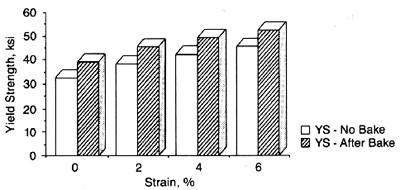
*A bake cycle of 1750C (3500F) for 20 to 30 minutes (simulating the paint-baking operation) increases the yield strength of bake-hardenable grades depending upon the degree of forming strain. However, even a flat unstrained area will increase in yield strength due to bake hardening.
Contact Us: email: [email protected]
Automotive Technical Bulletins
Home  Financial About Divisions Steel Links Products
Markets What's New
Financial About Divisions Steel Links Products
Markets What's New
E-mail comments to: [email protected]
�1998, Bethlehem Steel Corporation