 |
Bethlehem Steel Corporation
1996 Environmental Progress Report
Managing Environmental Performance
- Environmental Audits
- Environmental Management Systems
- Reducing Toxic Emissions
- 33/50 Chemicals
- Solvent Reduction Program
- Superfund Sites
- Managing PCBs
- Underground Storage Tanks
- Energy Conservation
- Charts
Environmental Audits
Environmental performance is also monitored through our comprehensive environmental
auditing process. Using teams consisting of business division, corporate and contract
personnel, we conducted comprehensive environmental audits at seven Burns Harbor Division
departments in 1996 and identified areas for improvement at both the division and
department levels. We conducted other audits at our Lackawanna Coke Division and at
BethShip-Sparrows Point. In addition, we conducted audits at Walbridge Coatings, in which
the company holds an investment interest, and at some of the off-site hazardous waste
treatment, storage and disposal facilities which Bethlehem uses or might use.

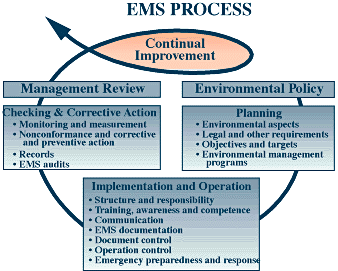 Environmental Management Systems
Our environmental policy and programs are implemented at each business division, which is
ultimately responsible for compliance. Each business division maintains an environmental
plan to guide its compliance efforts. EPA, the states and our corporate audits serve
as external checks on the process and ensure acceptable results. The needs of
external stakeholders, such as the community, also influence the plans.
Bethlehem’s model for an environmental management system (EMS) process is one of
continual improvement. It is designed to satisfy our obligations to all of our
stakeholders and our commitment to the CERES Principles and the International Chamber of
Commerce Business Charter for Sustainable Development.
In 1996 we published an environmental management system manual intended to serve as a
policy guide for the development and implementation of Environmental Management Systems at
each business division. The manual is consistent with EMS requirements for
certification set forth in ISO 14001. We are presently benchmarking other industries with
respect to ISO 14001 and have initiated an ISO 14001 pilot project at our Burns Harbor
Division.
Reducing Toxic Emissions
Charts
Section 313 of the Superfund Amendments and Reauthorization Act of 1986 (SARA) requires
annual reporting for specifically listed toxic chemicals manufactured, processed or
otherwise used at a facility above certain threshold levels.
In 1995, Bethlehem Steel reported total toxic chemical releases to the environment of 4.4
million pounds, a reduction of 23 percent from the 5.7 million pounds reported in 1994 and
79 percent from the 21.4 million pounds initially reported in 1987. Total releases include
on-site releases as well as off-site transfers that are treated or disposed of in
landfills.
There are several reasons for this dramatic reduction of releases over the past few years,
including the following waste reduction strategies:
- Modifying existing operations and installing new technologies
- Recycling tar sludge and baghouse dusts
- Substituting water-based paints, citrus degreasers, nonleaded lubricants and other products for existing consumables
- Eliminating underground storage tanks
- Segregating wastes
- Discontinuing purchases of environmentally unsafe solvents
- Training and educating employees on the prevention of releases
33/50 Chemicals Charts
Bethlehem Steel has been a participant in EPA’s voluntary emission-reduction program
known as 33/50 since its inception in 1991. This program called for reducing 17 types of
chemical emissions (from a 1988 baseline) 33 percent through 1992 and 50 percent through
1995. Bethlehem made a commitment to meet and exceed the EPA challenge.
Between 1988 and 1992, we reduced the ten 33/50 toxic chemicals generated at our
operations by 70 percent, from 5.4 million pounds to 1.6 million pounds. This reduction
not only surpassed EPA’s 1995 50-percent target, but did so by 1992, three years
ahead of schedule. By 1995, the last year of the program, we achieved an 88-percent
reduction of the targeted chemicals. As a result of this performance, Bethlehem Steel was
recognized by EPA in 1996 as one of 20 “Environmental Champions” for achieving
and exceeding their 33/50 Program goals. Even though the program has officially ended, we
will continue to track these chemicals and remain committed to further emission reductions
of all chemicals in future years.
Solvent Reduction Program
Charts
Bethlehem implemented a solvent reduction program several years ago. We have replaced most
of the ozone-depleting degreasing solvent 1,1,1-trichloroethane (TCA) with more
environmentally friendly solvents. In 1988, we used 1.1 million pounds of TCA, which by
1995 was reduced more than 97 percent to 28,000 pounds. All plants recycle degreasing
solvents and have programs for substituting organic solvents with other types of materials
that present fewer risks to the environment if released.
Superfund Sites Charts
EPA has the authority to impose liability for site remediation on waste generators, past
and present site owners and operators regardless of fault or legality of the original
disposal activity under the Comprehensive Environmental Response, Compensation and
Liability Act (CERCLA or Superfund). In 1996, Bethlehem was actively involved at 25 sites
where EPA or a state regulatory agency had advised the company that it may be considered a
“potentially responsible party” for site remediation. Bethlehem’s share of
costs for remediation is not expected to be material because we are minor contributors in
terms of waste volume at most of those sites. Our policy is to manage our waste streams
on-site whenever possible, and we have effectively done that over the past few years.
Managing PCBs Charts
All business units have taken steps to manage the potential environmental risk from
polychlorinated biphenyls (PCBs) by starting transformer/capacitor replacement programs.
Business units have replaced or retrofitted PCB capacitors and transformers, and some have
installed containment devices to control potential spills.
Underground Storage Tanks
Charts
Another measure of environmental performance is our progress in reducing the number of
underground storage tanks at our facilities. In 1996, we removed one of the
remaining 10 tanks. From 1985 through 1996, we removed, closed in place or sold almost 98
percent of our underground storage tanks containing petroleum products. We believe that
management of tanks in this manner has significantly reduced our liabilities relative to
accidental releases and spills of petroleum to the environment.
Energy Conservation Charts
Bethlehem’s total energy consumption in terms of BTUs per ton of steel produced at
our steelmaking operations has remained relatively unchanged during the past five years.
Consumption of energy at existing facilities decreased through conservation efforts but
the installation of new finishing facilities, such as coating lines, and pollution control
equipment, added new energy requirements without changing the baseline tonnage.
Our energy policy put in to practice includes:
- Promoting energy awareness through communication with employees
- Training and educating key process operators
- Developing effective energy reduction programs
- Promoting operating practices that minimize energy use
- Using by-product fuel and capturing process heat
- Applying economic and environmental “best-available” energy-use technology
- Setting energy usage targets per operating cycle
- Employing qualified personnel to develop, implement and monitor the company’s energy use
- Evaluating and assessing performance and adjusting when necessary
Safety, Health and Environment Department
1170 Eighth Avenue, Martin Tower; 12th Floor, Bethlehem, PA 18016-7699
For further information about this report, send mail to [email protected]
1996 Environmental Report Table of Contents
If you have any questions or comments, please Contact Us
�1999, Bethlehem Steel Corporation