Bethlehem Steel Corporation
1995 Environmental Progress Report
Managing Environmental Performance
| Environmental Management System | Substituting or Eliminating Consumables |
Environmental Management System
Our environmental policy and programs are implemented by the business units, which are ultimately responsible for compliance. Each business unit develops an annual environmental plan to guide compliance. EPA, the states and our corporate audits provide external checks on the system. The needs of external stakeholders, such as the community, also influence the plans. The goal is to promote achievement of desired results. Underlying the process is our environmental management system, which includes the organizational structure, planning, activities, responsibilities, practices, procedures and resources for implementing and maintaining the environmental policy.
Reducing Toxic Emissions 
Bethlehem Steel has dramatically reduced toxic chemical emissions in the past few years. In 1987, we released 21.4 million pounds of toxic chemicals to air, water and land. By 1994, we reduced releases to 5.8 million pounds, a 73 percent reduction. (Six graphs)
Most environmental success came from modifying existing operations and installing new technologies. In three large projects, for example, we installed gas blanketing systems at the coal chemical operations at the Lackawanna, Burns Harbor, and Bethlehem Structural Products facilities to reduce emissions of chemicals including benzene, toluene and xylene.
Burns Harbor has undertaken a project to reduce its permitted underground disposal of process waters by injection by installing an innovative stripper technology to reuse one waste stream instead of disposing of it. The division will continue to pursue new markets for the beneficial reuse of another permitted waste stream, which is injected into deep wells.
Besides making technological changes, other waste reduction strategies include the following steps practiced at all plants:
- Recycling tar sludge and baghouse dusts
- Substituting water-based paints, citrus degreasers, nonleaded lubricants and other products for existing consumables
- Eliminating underground tanks
- Segregating waste
- Discontinuing purchases of environmentally unsafe solvents
- Training employees to prevent releases
Because the EPA recently added another 286 substances to the list of reportable chemicals, we expect that the quantities we will report in 1996 for the Toxics Release Inventory year 1995 will increase. However, we will continue to work to reduce not just the "reportable" releases, but all our releases to the environment.
33/50 Chemicals
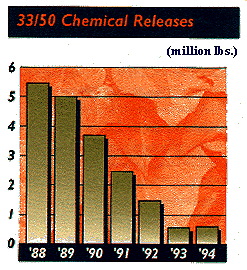 Bethlehem Steel was already reducing benzene, toluene and xylene emissions when, in 1990,
the EPA asked industries to participate in a voluntary emission-reduction program known as
"33/50." This program called for reducing 17 types of chemical emissions (from a
1988 base line) 33 percent by 1992 and 50 percent by 1995. Bethlehem committed to meet and
exceed the EPA challenge.
Bethlehem Steel was already reducing benzene, toluene and xylene emissions when, in 1990,
the EPA asked industries to participate in a voluntary emission-reduction program known as
"33/50." This program called for reducing 17 types of chemical emissions (from a
1988 base line) 33 percent by 1992 and 50 percent by 1995. Bethlehem committed to meet and
exceed the EPA challenge.
Between 1988 and 1992, we reduced the ten "33/50" hazardous chemicals generated at our operations by 70 percent, from 5.4 million pounds to 1.6 million pounds. This reduction not only surpassed EPA's 1995 50-percent target, but did so by 1992 -- three years ahead of schedule. By 1994, we achieved an 88 percent reduction of the targeted chemicals! As a result of this performance, Bethlehem Steel was recognized by EPA and McGraw-Hill publications as one of 20 "Environmental Champions" among the 1300 participants in this voluntary pollution prevention initiative. We remain committed to further emission reductions in future years.
Modifying Processes
Making technological changes is one way Bethlehem Steel has reduced the emission of coal chemicals and particulate matter.
Bethlehem Steel spent about $65 million to reduce benzene, toluene, and xylene emissions at Bethlehem Structural Products, Burns Harbor and Lackawanna.
Along with benzene, toluene and xylene, emissions of naphthalene, another important coal chemical, were reduced at the Lackawanna and Bethlehem Structural Products' Coke Divisions. Multistory mixer-settler processing tanks and state-of-the-art computer-control centers now recover naphthalene from process water. Bethlehem coke plants have reduced air emissions of naphthalene by 59 percent since 1988.
Burns Harbor rebuilt its coke oven battery to meet Clean Air Act regulations, including up-to-date technology to reduce particulate emissions from coke oven doors.
Bethlehem Structural Products also built a shed and a baghouse for one of its batteries and rebuilt two state-of-the-art emission scrubber cars for its other batteries. Both of these systems significantly reduce particulate emissions.
Substituting or Eliminating Consumables
Waste also can be reduced by substituting one consumable for another or by reducing or eliminating others.
PCBs
All business units have taken steps to manage the potential environmental risk from
polychlorinated biphenyls (PCBs) by starting transformer/capacitor replacement programs.
Bethlehem Structural Products has replaced all of its PCB capacitors, Burns Harbor has
been retrofitting and replacing transformers and has installed containment devices to
control potential spills, and Sparrows Point is involved in a replacement program.
Solvent Reduction Program
Bethlehem replaced much of the ozone-depleting degreasing solvent 1,1,1-trichloroethane
(TCA) with more environmentally friendly solvents. In 1988, we used 1.1 million pounds of
TCA, which by 1994 was reduced 96 percent to 39,000 pounds.
Burns Harbor replaced TCA with other substances. Sparrows Point reduced its releases by 89 percent. Pennsylvania Steel Technologies went from 21,000 pounds to none and Bethlehem Structural Products reduced releases by 30 percent.
All plants recycle degreasing solvents and have programs for substituting organic solvents with other types of materials that present fewer risks to the environment if released. For example, Pennsylvania Steel Technologies is examining how often its cleaning stations change solvents and will try to reduce the amount of recycling sent off site. Pennsylvania Steel Technologies anticipates eliminating some cleaning operations and reducing the frequency at which solvents must be replaced.
Segregating and Recycling Materials
Bethlehem Steel has been an industry leader in finding uses for waste materials. Segregation is a key element in effective recycling. Bethlehem Structural Products, for example, segregates inert refuse such as dirt, glass, nonrecyclable brick, sand, mortar and building materials to remove metals. These, in turn, are segregated into containers as either ferrous or "other" types or materials. This facility has accomplished what no other steel plant has--it eliminated the need to use an on-site landfill for nonhazardous wastes. Burns Harbor also has no onsite landfill.
Burns Harbor is in the midst of a $26-million integrated waste management and recycling project, which when completed in 1997 will recycle about 235,000 tons of waste per year.
Pickle Liquor
Spent pickle liquor (hydrochloric and sulfuric acid) is a good example of recycling.
Pickle liquor is produced when cleaning steel sheet in a process called pickling. This
acid-bearing waste can be substituted for a commercial chemical product purchased by waste
water treatment facilities. Alternatively, the iron can be removed to make magnetic tapes
and disks with the cleaned acid being returned to the pickling process.
Lackawanna uses or sells all of its pickle liquor as a water treatment chemical. Sparrows Point uses seven million gallons of pickle liquor in its waste water treatment plant each year and sends the rest (approximately 25.8 million gallons per year) to a publicly-owned treatment works. Burns Harbor sells most of its spent pickle liquor.
Baghouse Dusts
Some pollution control baghouse dusts also can be sold. Sparrows Point sold 550 tons of
baghouse dust in 1993. Bethlehem Structural Products sold 400,000 tons of slag from
steelmaking as a raw material to a plant that makes mineral wool and other products. It
also sells particulate from steelmaking to a cement manufacturer.
Mercury
Bethlehem Structural Products and Burns Harbor send waste mercury from monitoring
instruments to recycling companies.
Drums
In another recycling effort, Sparrows Point, Burns Harbor, Pennsylvania Steel Technologies
and Bethlehem Structural Products have implemented drum-control programs. In these
programs, drums in good condition are returned to vendors for reuse. Those drums that
cannot be reconditioned and reused are recycled as scrap. Bethlehem Structural Products
installed special drum-storage spill-prevention containers throughout the plant to catch
drips or spills before they reach the ground. It also negotiated with vendors to supply
some substances in drums lined with plastic bags that prevent in-drum leftovers and make
it easier to reuse the drums.
Oil
All plants recycle their used oil either internally or through vendors who process it for
reuse or send it back to the plant as fuel.
Tar Sludge
Coke ovens at Burns Harbor, Bethlehem Structural Products and Lackawanna recycle all tar
sludges to their batteries for use in coke making. As an example, Burns Harbor recycles at
a rate of rate of about 900,000 gallons a year.
Coke Breeze
In 1990, Lackawanna built a hugh metal shed over its coke ovens to capture particulate
from making coke. The material is captured in a baghouse and is then sold with
fine-particle coke (breeze) as a product.
Steel Cans
Bethlehem Steel is a major contributor to the nation's general recycling and waste
reduction effort by using steel cans in making steel. Pennsylvania Steel Technologies won
a Governor's Waste Minimization Award from the Commonwealth of Pennsylvania several years
ago for its steel can recycling efforts. Bethlehem Structural Products and Pennsylvania
Steel Technologies recycled more than two billion "tin" cans in 1991. This
recycling helps communities reduce their landfill waste, reuses an otherwise wasted
resource (the steel) and reduces steelmaking wastes generated when raw steel is made.
Reducing Municipal Waste
Bethlehem Steel has been reducing its municipal waste for several years by a variety of methods that include recycling paper, cans and wood, and purchasing different products. Segregation and recycling make good economic and environmental sense and Bethlehem supports such efforts.
In addition to recycling paper and cardboard, several business units recycle scrap wood as wood chips. Sparrows Point began a wood recycling program in 1994 and expects to recycle 4,000 tons of wood per year.
In response to its commitment as a 1994 charter member of EPA's WasteWi$e program, he corporate offices reduced the use of copier paper in 1995 by 37,600 pounds through two-sided copying and electronic data exchange. Corporate offices also recycled 141,000 pounds of corrugated paper, 185,675 pounds of high-grade office paper, 72,400 pounds of mixed office paper and 3,360 pounds of aluminum and glass.
Paper recycling programs were also implemented at Burns Harbor and PST. At Burns Harbor, the estimated annual recycle rate is 24,000 pounds of paper, which saves an estimated 204 trees, 84,000 gallons of water and enough energy to heat and cool five 2,000-square-foot homes. PST recycled 66,000 pounds of office paper in 1995, saving almost 500 trees, reducing air and water pollution by 73 and 35 percent, respectively, and saving 270 million BTU in energy!
Energy Conservation Starts with Policy
Bethlehem's energy policy is "to use energy, in all of its forms, in the most cost-effective and environmentally sound manner and to promote and apply best-available energy-use technologies."
Bethlehem's total energy consumption in terms of BTUs per ton of steel produced at our steelmaking operations decreased approximately four percent from 1991 to 1995. Over the past 20 years, Bethlehem's consumption of BTUs per ton has decreased by almost 30 percent.
Because of the energy-intensive nature of steelmaking and the cost of energy, we have been conserving energy for more than 20 years. The greatest reductions were seen in the mid-1970s through the mid-1980s. During the last 10 years, we have continued to reduce consumption through a variety of conservation measures such as:
- upgrading combustion controls and instruments
- decreasing the coking rate to better control blast furnace burden
- retiring older, less efficient facilities, such as blast furnaces and other equipment
- repairing steam leaks and deactivating unused steam lines
- training operators
- managing boiler systems
- installing two world-class walking reheat furnaces at Sparrows Point
- improving furnace maintenance and minimizing blast furnace gas bleed
- improving refractory materials and practices
Superfund Sites
Under the Comprehensive Environmental Response, Compensation and Liability Act (CERCLA or Superfund), EPA has the authority to impose liability for site remediation on waste generators, past and present, site owners, and operators regardless of fault or legality of the original disposal activity. Bethlehem is actively involved in 22 sites where EPA or a state regulatory agency has advised the company that it may be considered a "potentially responsible party" for site remediation. For the most part, we are minor contributors in terms of waste volume at those sites. Therefore, Bethlehem's share of costs for remediation is not expected to be significant.
Safety, Health and Environment Department
1170 Eighth Avenue, Martin Tower; 12th Floor, Bethlehem, PA 18016-7699
For further information about this report, send mail to [email protected]
Environmental Report Table of Contents
If you have any questions or comments, please Contact Us
�1999, Bethlehem Steel Corporation