

 |
 |
For Low-Carbon, Low-Sulfur, 50 ksi Minimum Yield Strength, As-Rolled Steel PlateV-Star 50 is a low-carbon, low-sulfur, 50 ksi yield strength, as-rolled plate grade. It is available in thicknesses up to 0.875 inch. This low-carbon, low-sulfur composition offers improved toughness and weldability when compared to other ASTM A572 Grade 50 grades. V-Star 50's improved toughness will prove particularly valuable on machinery designed for cold-weather use, construction equipment, rail cars and other demanding applications. Its improved formability and weldability will help increase fabricators' productivity and reduce final product costs. V-Star 50 meets all the requirements of ASTM A572 Grade 50 Type 2. Welding SuggestionsV-Star 50 is readily weldable using conventional arc welding processes. Providing appropriate procedures are followed, V-Star 50 weldments possess tensile strengths equivalent to those of the base metal and notch toughness adequate for many applications. Normally, only room temperature preheats are necessary for plate thicknesses between 3/16" and 3/4". Notes:Other electrode, electrode/flux or electrode/gas combinations depositing weld metal different in strength and toughness from the classifications listed in chart at right may be used or required, depending on design and application. Use only low-hydrogen welding materials and practices. Welding material selection should include adequate weld metal notch toughness for the application.
Carbon equivalent values (CEIIW and Pcm ) are used to compare relative ease of welding. The tabulated values correspond with the maximum carbon equivalent values of V-Star 50. These values are based on the following empirical equations:
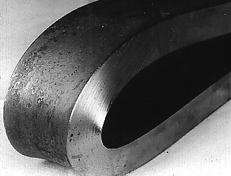
V-Star 50's improved weldability saves on fabricating costs by reducing preheat requirements.V-Star 50 is readily weldable using conventional arc welding processes. Specified base metal strength and toughness can be maintained into the weld zone, provided proper welding consumables and normal levels of heat input are used. V-Star 50's low-carbon content and carbon equivalent generally reduce preheat requirements for many applications. And that translates into real savings in fabrication costs. When the base metal temperature is below 32�F (0�C), the base metal should be preheated to at least 70�F (21�C) and this minimum temperature maintained during welding. V-Star 50's superior toughness and strength provide low final applied cost.V-Star 50's notch toughness, combined with a 50 ksi minimum yield strength, extends the range of economical plate grades available to designers. V-Star 50 is ideal for fabrications where formability, weldability, and optimum strength/toughness combinations are essential. V-Star 50's outstanding formability simplifies difficult fabrication and saves on final cost.The excellent formability of V-Star 50 is associated with a low-sulfur content (0.010 max.), and the associated reduction in the number of manganese sulfide type inclusions. V-Star 50 plates are readily formable at room temperature if proper procedures are used. The suggested minimum inside bend radius for transverse bends is 1.5 t. As a precaution, sharp notches on the edge of plates - resulting from shear breaks or torch cutting - require removal by grinding or machining to prevent cracking during severe forming. MetallographyV-Star 50's microstructure consists of a ferrite-pearlite aggregate. View photomicrograph for a 1/2"-thick V-Star 50 plate (49K .GIF). The volume fraction of pearlite is 9% and the ferrite grain size is 14 �m. (ASTM #9.0). View photograph showing a 1/2"-thick V-Star 50 plate bent at room temperature (48K .GIF).
|
||||||||||||||||||||||||||||||||||||||||||||||||||||||||||||||||||||||||||||||||||


Contact Us  1-800-543-2127
Burns Harbor Burns Harbor Products
Home Financial About Divisions Steel Links Products Markets What's New
E-mail comments to: [email protected]
�1998, Bethlehem Steel Corporation