

 |
 |
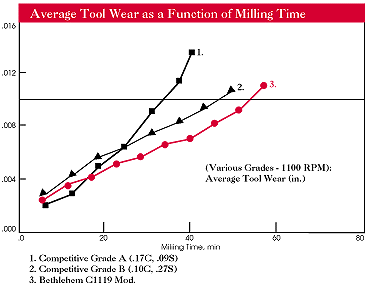
Bethlehem C1119/C1144 Modified SteelsLonger tool life/increased machining ratesBethlehem C1119 Mod. and C1144 Mod. free-machining steel plates offer users significant overall cost savings when compared to conventional machining grades. Tool life is extended and machining time is usually decreased. Surface finish, internal soundness and dimensional stability may also be improved. For many applications, the advantages of Bethlehem's free-machining steel plates can translate into significant dollar savings for the end user. Bethlehem produces two grades of free-machining steel plates: C1119 C1144 Mod. offers higher strength and hardness and is applicable where resistance to deformation and wear are essential. It may be flame hardened to further enhance surface properties. It is frequently used as an economical replacement for more expensive quenched-and-tempered alloy grades. Typical applications include gears, sprockets, molds, dies, cams and machine ways. C1119 Mod. is an ideal grade for many applications requiring extensive machining and smooth surface finish. It may also be flame hardened to locally improve surface properties. Improved machining characteristics reduce machining costs and residual stresses, while improving surface finish in comparison to ordinary grades. Typical applications include machinery bases, plastic and rubber molds, threaded parts and die holders. Bethlehem's free-machining steels are available in thicknesses from 3/16 in. to 12 in. and in widths from 36 in. to 144 in. Maximum widths and lengths are dependent on thickness. Availability of representative sizes is shown in the table above. Bethlehem C1119 Mod. and C1144 Mod. free-machining steels may be ordered in either the normalized or annealed condition. Product DescriptionMachinability, defined as the relative ease with which metal may be cut or machined by a cutting tool, is affected by several variables, including chemical composition, microstructure and mechanical properties. Bethlehem's free-machining steel plate grades offer an excellent combination of composition and microstructure that results in outstanding machinability. The advantages of Bethlehem's free-machining steel are shown in the graph on the next page, which compares tool life wear test results for Bethlehem C1119 Mod. and two competitive grades. The superiority of Bethlehem's free-machining steel is demonstrated by the longer time necessary to effect .01 in. of tool wear in a standard milling operation.
Excellent internal and external qualitiesInternal soundness and the ability to develop a smooth machined surface are important for many end uses, such as dies and hydraulic components. Sophisticated ladle metallurgy strikes the appropriate balance between maximized machinability and clean, sound internal structure. Also, bottom pouring helps further ensure surface integrity and internal soundness. Evidence of Bethlehem free-machining steels excellent internal soundness is demonstrated by the fact that the grades can be ordered to ultrasonic testing standard ASTM A435. Users benefit as a resultThe excellent internal soundness and surface integrity of Bethlehem's free-machining steels assure fewer part rejections - a particularly important cost consideration when complex machining applications are involved. And, part fit is usually improved because Bethlehem's C1119 Mod. and C1144 Mod. steels offer superior dimensional stability compared to competitive materials. When you add up all the benefits - reduced machining time, extended tool life, reduced part rejections and better part fit - you end up with an unbeatable pair of cost-effective free-machining steels.
|
||||||||||||||||||||||||||||||||||||||||||||||||||||||
Contact Us  1-800-543-2127
Burns Harbor Burns Harbor Products
Home Financial About Divisions Steel Links Products Markets What's New
E-mail comments to: [email protected]
�1998, Bethlehem Steel Corporation