| Burns Harbor is the only steelmaking facility in America
bounded on two sides by a national park. Bethlehem and its Burns Harbor
Division have a long history of commitment to environmental protection, operating under a
policy that is straightforward and uncompromising: "We will comply with all
environmental laws and regulations applicable to the conduct of our business. As a good
corporate citizen, we are dedicated to the continuous improvement of the environment in
which we all live."
 Meeting the
environmental challenge Meeting the
environmental challenge
The making and processing of steel at Burns Harbor involves handling vast amounts
of raw materials such as coal, iron ore, limestone and scrap, as well as large amounts of
air, water and energy. High-temperature chemical reactions and physical changes that occur
during smelting, refining and other processing steps generate solid and gaseous emissions,
contaminate process water and produce waste materials. The challenge is to make steel
without adversely impacting the environment. It is a challenge that Burns Harbor meets
every day.
Keeping the air clean by trapping gases and particulate matter before they
escape into the atmosphere.
Bethlehem Steel continues to invest millions of dollars to protect the
environment. High-energy wet scrubbers and baghouses are used to trap gases and
particulate matter and prevent them from being released into the atmosphere. In addition,
practically all matter captured by these pollution-control systems is converted into a raw
material, called sinter, that is fed back into the blast furnaces and recycled.
Water is treated as one of our most important assets.
Water is essential to steelmaking and Burns Harbor uses over 300 million gallons
each day. Much of the water never comes in contact with impurities and is reused. Dirty
water, however, is cleaned in a modern treatment plant before being returned to the
environment.
Primary treatment removes oxides, scale and oil. The water then passes to the secondary
wastewater treatment facility for further purification. After that, it flows through
conveyance lagoons.
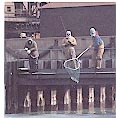 While some of the treated
water is reused, most of it is returned to Lake Michigan, clean and without harmful
pollutants. As a matter of fact, the treatment program has been so effective that boating
and fishing thrive in the stream through which the treated water flows on its way to the
lake. While some of the treated
water is reused, most of it is returned to Lake Michigan, clean and without harmful
pollutants. As a matter of fact, the treatment program has been so effective that boating
and fishing thrive in the stream through which the treated water flows on its way to the
lake.
Innovative solid waste recycling.
An innovative solid waste recycling system, developed by Bethlehem engineers,
converts recaptured iron and carbon into a feedstock that is recycled in the blast
furnaces. The project reduces by 200,000 tons annually the quantity of waste that
otherwise would have to be sent to a landfill.
Almost everything is recycled in the steelmaking process.
Captured emissions and oils are only part of what is recycled at Burns Harbor.
Steel, itself, is America’s most recycled product, and each year more than one
million tons of steel scrap are recycled into new steel in Burns Harbor’s basic
oxygen furnaces.
There are also many other ways recycling plays a key role in the Burns Harbor
environmental-control program. BOF and blast furnace slag is processed and sold for
roadway ballast or insulation. By-products from the coke-making operation are sold to
firms that use them in the manufacture of fertilizer, paint, pharmaceuticals and synthetic
fibers. Waste pickle liquor, a by-product of a cleaning operation in the cold-sheet mill,
is captured and sold to cities for use as a neutralizing agent in sewage treatment plants.
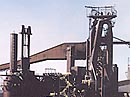 Over $200 million
has been invested in protecting the environment. Over $200 million
has been invested in protecting the environment.
Since Burns Harbor began operating in 1964, Bethlehem has invested over $200
million to install environmental-control equipment at the plant. In addition, over $30
million is spent each year to maintain and operate the equipment.
The cost is high, but so are the benefits. Indiana Dunes National Lakeshore, a national
park next to the plant, provides a clean environment for both people and wildlife. Fish
are caught year-round near the plant’s warm-water discharge, and the treated effluent
flowing from the conveyance lagoons supports recreational activities in nearby streams. |


 Burns Harbor
Facilities
Burns Harbor
Facilities