| From start to finish, Burns Harbor puts the best technology in the
hands of the best people. Burns Harbor combines advanced technology and computerization
with highly trained people to make clean steel with tightly controlled, uniform chemistry.
This, in turn, produces finished products with superior internal cleanliness, surface
quality and formability. Computer-controlled material-handling system
facilitates raw material storage and processing.
The Burns Harbor steelmaking process starts with raw materials from Bethlehem’s
secure, long-term reserves. The movement of these materials to and from the storage yards,
through the blending process and into the blast furnaces, is controlled by one person,
using Burns Harbor’s unique computerized material-handling system.
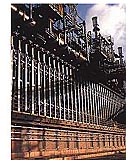 Coal is converted to
coke in environmentally sound coke ovens. Coal is converted to
coke in environmentally sound coke ovens.
The Burns Harbor plant has two coke oven batteries, each containing 82 ovens, which
convert coal to coke. To make coke, coal is fed into tightly sealed ovens and baked, in
the absence of oxygen, for about 18 hours. Coke is 90% pure carbon and is used as fuel in
the blast furnaces. Each battery uses advanced technology to control emissions.
The Burns Harbor Division also operates two 76-oven coke batteries located in
Lackawanna, N.Y.
Two blast furnaces yield 14,000 tons of molten iron per day.
In the ironmaking process, iron ore pellets, coke and other raw materials are fed by
conveyor belt into the top of a blast furnace. A "blast" of hot air is forced
into the furnace, igniting the coke and producing intense heat that melts the pellets.
After being collected in a pool inside the furnace, the molten iron is released through a
taphole and flows through a channel into a metal transfer car for transport to the
steelmaking shop. Each of Burns Harbor’s two blast furnaces normally yields 7,000
tons of high-quality iron per day.
Iron is refined into steel in basic oxygen furnaces.
At the steelmaking shop, molten iron, steel scrap and fluxes are charged into a basic
oxygen furnace (BOF). Liquid oxygen is blown into the BOF with supersonic velocity,
generating high temperatures and chemical reactions that oxidize the impurities in the
metal and convert the iron into steel. The molten steel is continuously tested and its
chemistry rigidly controlled to exacting specifications. Each of Burns Harbor’s three
BOFs can make approximately 300 tons of molten steel in 30 minutes.
Further refining of the molten steel enhances Burns Harbor’s ability to
produce steel to world-class quality standards.
- Ladle desulphurization improves steel cleanliness, formability and surface quality.
- Computerized ladle treatment controls chemistry and temperature.
- Vacuum degassing produces ultra-low-carbon steels with increased strength and
formability.
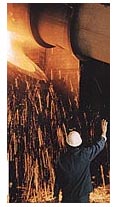 Continuous slab
casters produce internally clean slabs with highly consistent chemistry. Continuous slab
casters produce internally clean slabs with highly consistent chemistry.
Burns Harbor has two computer-controlled continuous casters that convert molten steel into
semi-finished slabs with exceptional internal cleanliness and uniform properties. In the
casting process, molten steel flows from a huge ladle through a series of water-cooled
copper molds. The steel gradually solidifies as it passes through the molds, and in about
45 minutes, emerges from the caster as a continuous slab. The continuous slab is then cut
into individual lengths, which are transported by mobile carriers to the slab yards
serving the hot-strip and plate mills.
Ingot Production
Ingots are poured for thicker plate product and for alloy and resulphurized,
free-machining grades of plates. |


 Burns Harbor
Facilities
Burns Harbor
Facilities