|
|

| |

Pennsylvania Steel Technologies
Steelmaking Process
Overview
Located in Steelton, Pennsylvania, near Harrisburg, PST uses electric furnace steelmaking and a continuous caster in the production of
rails for the rail transportation industry, specialty blooms for the forging and
re -rolling industries, and flat bars for cold-drawing and other industrial applications. It is one of only two rail producers in the United States. PST also produces
forging quality ingots.
Facilities
Pennsylvania Steel Technologies completed a modernization program in late 1994, designed to establish itself as the premier North American producer of high quality rails, flat bars and specialty blooms. The program included a state-of -the-art DC electric furnace, a ladle furnace, a vacuum degassing unit, and in-line rail head-hardening equipment.
Principal facilities include two electric arc furnaces with an annual raw steel production capability of about 1.1 million tons, a continuous bloom caster, a 44-inch blooming mill, a 20-inch bar mill, a 35-28-inch rail mill, and finishing and shipping facilities for long-length (80 foot) rails.
Rail Manufacturing Process
 |
1. DC Electric Arc Furnace Direct current technology
provides PST with the best available means of making steel.
Advantages include large heats, more heats per day, greater
consistency and greater reliability. This results in
significantly better steel quality. Also, the eccentric bottom
tapping promotes more efficient tapping and cleaner
steel.
|
|
 |
 |
2. Ladle Arc Reheating Furnace This furnace performs
additional steel refining by providing excellent temperature
control and precise chemical adjustment capabilities. It
provides steel to the Jumbo Bloom Caster at the correct
temperature, chemistry and time. Argon stirring, through a
porous plug in the bottom of the ladle, promotes the
homogeneous mixing of additives to the ladle, assists in
temperature control and promotes the flotation of non-metallic
inclusions.
|
|
|
 |
3. Tank Vacuum Degasser Most importantly, vacuum
degassing lowers the hydrogen content of the liquid steel.
Argon stirring during degassing also assists the removal of
hydrogen and further improves steel cleanliness. Clean
steelmaking practices, combined with the benefits of the Ladle
Furnace and Vacuum Degasser, means that the Jumbo Bloom Caster
receives steel with significantly improved internal
cleanliness levels, correct chemistry and correct temperature
at the correct time. This results in improved rail fatigue
life.
|
|
|
 |
4. Continuous Jumbo Bloom Caster The Jumbo Bloom Caster
produces the cleanest rail steel possible, because it
eliminates reoxidation by completely shrouding the molten
steel from the atmosphere, which prevents the formation of
harmful non-metallic inclusions. Rapid solidification
affects the inclusion distribution. Those that remain tend to
be small, globular and more finely dispersed. Also, surface
quality is dramatically improved. The resultant blooms are
world-class quality, with a sound interior and excellent
surface � the ideal starting material for rolling mills.
Special casting practices and processes, developed by a
dedicated team of researchers and caster specialists, have
further improved the internal cleanliness of the blooms by
floating out additional remaining impurities.
|
|
|
 |
5. Soaking Pits Our soaking pits enable
the hot connection of the continuous cast bloom to the rolling
mills. Hot connection eliminates the potential thermal
cracking problems associated with cooling blooms to ambient
temperature and reheating. Also, the Soaking Pit Control
System has been updated completely with the latest computer
control technology.
|
|
|
 |
6. 44" Blooming Mill, 35" Rougher, 28" Rail
Mill Three separate mills are
used to roll the continuous cast blooms into finished rail.
Due to its jumbo size, each bloom requires many passes to
reduce it to the final rail section. The resulting 25-to-1
reduction ratio is much greater than any other producer of
rails from continuous cast steel.
|
|
|
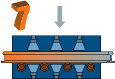 |
7. In-Line Head Hardening This unit, a 101-meter
in-line process at the exit end of the 28" Rail Mill, uses the
latent heat from the rolling process. The system is fully
computerized and uses water sprays to slack-quench the rail.
The resultant product is composed of pearlite with fine
inter-lamellar spacing, which provides rails with excellent
hardness and improved wear resistance. Residual stresses are
low, and straightness is excellent. The technology for this
system comes from CRM (Centre de Recherches Metallurgiques,
Leige, Belgium) and MMRA (Metallurgique et Miniere de
Rodange-Athus, Luxembourg). Produced by this technology, rails
used in heavy-haul service in the U.S. are performing to
world-class standards.
|
|
|
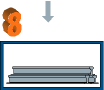 |
8. Controlled Cooling Rails are cooled in
long-length, insulated boxes to ensure the removal of any
remaining hydrogen gas. While the reduction of hydrogen
levels through vacuum degassing reduces the need for control
cooling, we continue to use control cooling of the rails to
further reduce the risk of hydrogen damage.
|
|
|
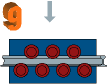 |
9. Roller Straightener Rails are put through a
two-plane roller straightening operation. Load levels are
continuously monitored to ensure the production of straight
rails without mechanical damage.
|
|
|
 |
10. In-Line Rail Inspection Includes utilization of
the following procedures and instruments:
� Visual Inspection
Station
� Ultrasonic Twist Gauge
measures elapsed time between two sound beams directed on the
base of the rail.
� DAPCO 300 Ultrasonic
Unit is state-of-the-art, fully computerized with an automatic
paint spraying system, and utilizes an array of transducers
mounted in neoprene wheels, strategically placed around the
rail to monitor internal quality.
� Laser Straightness Gauge
performs a three-point measurement of deviations throughout
the rail body. Laser beams are directed at the head of the
rail and data is monitored continuously by a computer.
� Optical Section
Measurement Unit automatically measures key dimensions of the
finished rail. Data is continuously collected and analyzed by
a computer to aid section control and allow further reduction
of section variability.
|
|
|
 |
11. In-Line Bar Coding Application
System This system
provides effective identification, inventory control and
shipping control for all rails shipped to customers. Bar code
tags can be used subsequently by customers in their rail
inventory, rail welding and field inspection
operations.
|
|
|
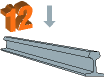 |
12. Shipping Rails are shipped in our
own fleet of long-length MTTX cars, specifically designed for
shipping 80' rails without banding. This reduces customer
unloading time. We can also ship rails in customer-owned
cars.
|
|
|
