
Trusses Still Offer Bridge Owners Low First Cost, Long Service Life
|
Introduction
This report features two (2) longspan truss bridges being built over the Ohio River: The Central Bridge in the Cincinnati area, and the Sixth Street Bridge in the Cincinnati area, and the Sixth Street Bridge at Huntington, West Virginia.
Many of our steel truss bridges have provided 100 or more years of service. At appropriate sites, this type of construction continues to be used for bridges in the short, medium and longspan categories.
(For background information on Truss Bridges, please refer to "Steel Bridges: The Best of Current Practice", pages 24-26, American Institute of Steel Construction, Inc., 1985.)
The Central Bridge Replacement Project
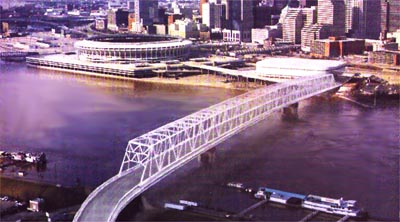
A sleek new Central Bridge with subtle grace and style will span the Ohio River between Newport, Kentucky and Cincinnati, Ohio, replacing the historic old Central Bridge. The new bridge, a three-span continuous, parallel chord, through truss will carry US 27 over the Ohio River and is scheduled to be completed during the summer of 1995.
| Trusses off a number of advantages. 1. Their relative light weight allows use of lighter hoisting equipment and can lead to savings in the substructure. 2. The domestic steel bridge industry has extensive experience in design, fabrication and erection of these structures. 3. They can be designed and built quickly. 4. They provide a large underclearance, a plus for both hydraulic and vertical clearance considerations. 5. Aesthetically pleasing designs are readily achievable. 6. As with other types of steel bridges, trusses can be inspected, evaluated and, if necessary, strengthened. 7. Reliable performance with long service life. Many trusses built before the turn-of-the-century are still in service! |
The new Central Bridge has been designed and constructed under the authority and funding of a federal demonstration project developed for the replacement, utilizes state-of-the-art design, techniques to expedite completion, improved inspection access details, and various innovative features and materials to provide low maintenance and long life to the structure.
History
The original Central Bridge, built in 1890-91 by the King Iron and Bridge Manufacturing Co., was the oldest existing highway cantilever truss bridge in Kentucky until its demolition in 1992 as part of this replacement project. This bridge, commonly referred to by bridge designers as the "Standard Cantilever Truss," served as the prototype for many cantilever truss bridges built later in the United States.
The narrow, two-lane, century old bridge had been modified and rehabilitated several times during its lifetime. Following an in-depth inspection conducted in 1980, the bridge was given an overall sufficiency rating of 5.0 (out of a possible 100.0) and the load rating reduced to three tons. Rehabilitation work contracted in 1984 extended the life of the structure (at the reduced load rating) until a contract could be let for its replacement.
Preliminary Design
The FHWA Alternate Bridge Design Policy, June 9, 1988 Federal Register Notice, page 21637, requires that at least two different bridge designs be prepared and provided in the project plans as alternate designs when the construction costs for a bridge exceed $10 million. Original estimates for the Central Bridge replacement placed the cost of a new bridge in the $30 million range. In compliance with the Alternate Bridge Design Policy, conceptual plans for variations on a steel truss and variations on a cable stayed bridge were considered for the replacement bridge.
The recommended steel alternate was a three span continuous parallel chord through truss. The recommended cable-stayed alternate consisted of two cable stayed spans and a continuous flanking span using a composite superstructure.
The Kentucky Department of Highways received eight bids for the construction contract, all for the steel truss alternate. C.J. Mahan Construction Co. of Grove City, Ohio, with a low bid of $25.9 million. was awarded the demolition and construction contract for the steel alternate.


If you have any questions or comments, please Contact Us
�1999, Bethlehem Steel Corporation