

Prepared by Construction Marketing * Bethlehem Steel Corporation * Bethlehem, PA 18016
Cypress Reconstruction--Contract E
Bethlehem Steel & Universal Structural, Inc.
|
BACKGROUND
On Tuesday, October 17, 1989, the first major earthquake in northern California since the
early 1900's hit the San Francisco Bay Area. The Loma Prieta earthquake measured 7.1 on
the Richter Scale and caused widespread damage to a variety of structures in the region.
Particularly hard hit were the long, two-level reinforced concrete viaduct sections of
freeway in San Francisco and Oakland. The greatest damage occurred to the I-880 Cypress
Viaduct, where approximately two thirds of a mile of viaduct collapsed. The loss of
service of this key freeway, linking Oakland, San Francisco, Berkeley and San Jose, caused
ongoing commuter problems and identified the need to evaluate different structure types
for the reconstruction.
After a good deal of study, the California Department of Transportation (CALTRANS) initiated a total rebuild of approximately 7.4 miles of freeway in this area. The project was divided into seven contracts with contract a at the I-880/I-980 interchange on the northern end. The total construction value of these contracts is in excess of $500 million.
| Steel in Seismic Zones This Steel Bridge Report cites the use of steel "tub" sections to rebuild a portion of a freeway viaduct damaged by a major earthquake. Steel continues to offer a number of advantages to designers of bridges and buildings in earthquake environments.
(For more information on steel's performance in seismic areas, contact us at (610) 694-5906 for a copy of Technical Bulletin TB-310, "Steel Proves Its Mettle Under Earthquake Conditions", June, 1992.) |
CONTRACT E
Bethlehem's Burns Harbor Division supplied the steel for the Contract E portion of the
project to Universal Structural, Inc. of Vancouver, Washington. Contract E involved the
I-80/I-880 interchange just east of the San Francisco-Oakland Bay Bridge, including a 2066
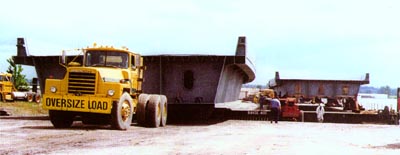
foot section of curved and elevated connector ramps. The design called for 13 single tub
sections 7� -0 deep by 35� -6 to
37� -6 wide, with lengths varying from 131 feet to 219 feet
per section. The sections ranged in weight from 250 tons to a maximum of 459 tons. All
sections incorporated a steel orthotropic deck and steel barrier rails. The total weight
of fabricated steel equalled 5014 tons. (See Table A below)
In addition to the size and geometric complexity of these sections, the contract included an 865 day completion clause for the general contractor, with very significant incentive and disincentive-incentive clauses. This requirement made the reliability of steel supply and fabrication crucial to the success of the project. It also provided the opportunity for the steel bridge construction industry to prove its ability to respond to such requirements in a timely and efficient manner.
BSC/USI
In response to these stringent contract clauses, USI turned to Bethlehem for assistance.
Over the years, Bethlehem's Burns Harbor Division and USI had developed a strong business
relationship, providing a sense of confidence that these demands could be met. In addition
to the usual competitive price and on-time delivery issues, USI required very specific
sequencing of material deliveries in order to enhance the efficiencies of their
operations. Quality product was essential in order to avoid potentially length CALTRANS
materials lab evaluations and approvals. Customer service and production scheduling
communications abilities were essential for tracing and scheduling the shop crews. Mill
production flexibility was necessary to react to both shop and mill production
falldowns--if they occurred. Transportation capabilities from the mill to the shop were
critical. A complicating factor was the large plate sizes which exceeded USI's
blast-cleaning capability, thus requiring an intermediate processing step prior to
delivery to the shop. Finally, USI wanted a single supplier capable of providing the full
range of plate sizes, as well as the processing and transportation services.
Bethlehem's Burns Harbor Division met all of these requirements. The combination of the 110� and 160� plate mills were capable of the full range of pate sizes required. Production scheduling personnel visited USI at their facility, and established a schedule satisfying both USI needs and plate mill availabilities. This line of communication was maintained throughout the project. Any falldowns, although at a minimum, were immediately resupplied so that no disruption of the shop schedules occurred. Burns Harbor, with its experience in processing and transportation, coordinated both, again with no disruptions to shop operations. No material rejections by CALTRANS occurred. Finally, Burns Harbor maintained its policy of competitive pricing, and a very cost-effective structure was achieved,
Table A.
Girder and Barrier Weights |
|||||
A1 |
A2 |
A3 |
A4 |
||
| Girder Length Girder Weight Barrier Weights Total Weight |
156'-2 1/16 726,288 125,040 851,328 |
200'11 829,471 138,701 968,172 |
218'-9 11/16 917,363 151,464 1,068,827 |
146' 11 7/16 628,958 101,163 730,121 |
|
A5 |
A6 |
A7 |
A8 |
||
| Girder Length Girder Weight Barrier Weights Total Weight |
146'-11 3/8 697,025 103,455 800,480 |
122'-9 15/16 538,133 83,623 621,756 |
130'-11 7/8 499,351 117,649 617,000 |
190'-7 9/16 723,307 93,535 816,815 |
|
A9 |
A10 |
A11 |
A12 |
A13 |
|
| Girder Length Girder Weight Barrier Weights Total Weight |
151'-8 3/8 653,549 76,996 730,545 |
137'-4 1/8 571,061 68,549 639,610 |
148'-1 15/16 570,110 71,085 641,195 |
181'-4 1/16 707,155 89,247 796,402 |
132'-2 7/8 545,865 67,010 612,875 |
CHRONOLOGICAL SUMMARY
Official Contract Award to USI: ..........April 21, 1995
Initial Material Order Placed:............... April 4, 1995
Initial Material Received:...................... June 6, 1995
Fabrication Started:..............................June 8, 1995
Fabrication Completed: .......................May 24, 1996
Initial Shipment: ...................................November 30, 1995
Final Shipment: ....................................May 26, 1996
5,000+ tons were delivered, fabricated and shipped in 418 days. The first segment was shipped to General Contractor 241 days from contract award.
| CONCLUSION Bethlehem remains ads the steel plate supplier dedicated to the fabricator and his needs. Bethlehem provides unmatched capabilities to its fabricator-customers--from size availability to flexible production schedules to technical support--that allow the satisfaction of the most demanding schedules and applications. In conjunction with the efforts of USI, Contract E of the Cypress Reconstruction Project was completed on time and within budget, thus demonstrating the abilities of steel in the bridge construction market. |
CREDITS
Owner: CALTRANS, Sacramento, CA
Engineer: ICF Kaiser Engineering & Construction Group, Oakland CA
Fabricator: Universal Structural, Inc., Vancouver, WA
Erector: Kiewit/Marmolejo, A Joint Venture
General
Contractor: Kiewit/Marmolejo, A Joint Venture
Home  Financial About Divisions Steel Links Products Markets What's New
E-mail comments to: [email protected]
�1998, Bethlehem Steel Corporation